English
 Español
 tiếng việt
 русский
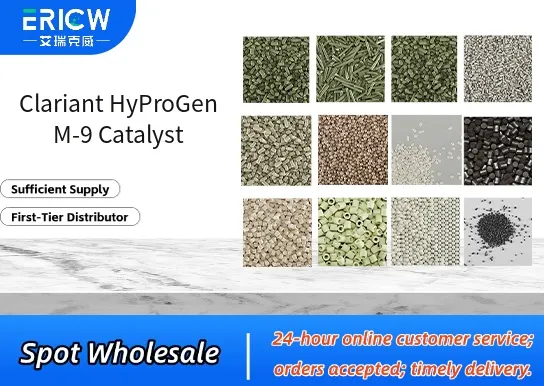
Highly selective hydrogenation catalyst optimized for mild operating conditions.
Robust nickel-based formulation with enhanced thermal and mechanical stability.
Low metal leaching performance ensures consistent activity and extended service life.
Designed for easy handling and safe industrial-scale loading into fixed-bed reactors.
Meets stringent regulatory requirements for food-contact and pharmaceutical intermediate synthesis.
Hydrogenation of unsaturated fatty acids in edible oil processing.
Selective reduction of nitro groups in fine chemical and agrochemical intermediates.
Conversion of aldehydes to primary alcohols in fragrance and flavor compound synthesis.
Catalytic saturation of dienes and alkynes in polymer precursor manufacturing.
Green hydrogenation processes requiring low-pressure (1–10 bar) and low-temperature (40–120 °C) operation.
| Chemical Type | Nickel-on-silica support with proprietary promoter system |
| Product Form | Extrudates (cylindrical pellets, 1.5–2.0 mm diameter) |
| Appearance | Gray-black free-flowing granular solid |
| Primary Applications | Selective liquid-phase hydrogenation under mild conditions |
| Key Features | High dispersion, low dust generation, reproducible batch-to-batch performance |
| Benefits | Reduced catalyst consumption, minimized downstream purification, improved process safety |
| Storage Conditions | Store in sealed containers under inert atmosphere at ambient temperature |
| Handling Precautions | Use in well-ventilated areas; avoid contact with air when reduced |
Q1: What is the primary function of HyProGen M-9 in polymer processing?
A: HyProGen M-9 is a heterogeneous hydrogenation catalyst designed to selectively reduce unsaturated bonds—particularly carbon–carbon double bonds—in thermoplastic polymers during melt processing. It enables controlled saturation without significant chain scission or crosslinking, supporting improved thermal stability and UV resistance in final products.
Q2: Which polymer systems is HyProGen M-9 typically compatible with?
A: The catalyst demonstrates effective performance in polyolefin-based systems—including EPDM, EPR, and functionalized polyethylene—and has been successfully applied in styrenic block copolymers and certain saturated elastomer blends. Compatibility should be verified under actual processing conditions due to sensitivity to residual catalyst poisons (e.g., sulfur, nitrogen, or halogen compounds).
Q3: How is HyProGen M-9 incorporated into polymer formulations?
A: It is typically introduced as a masterbatch or dry-blended powder prior to extrusion or compounding. Due to its heterogeneous nature, uniform dispersion is critical—twin-screw extruders with adequate mixing elements are recommended. Dosage depends on formulation requirements but generally ranges from 0.1% to 2% by weight relative to the base polymer.
Q4: Does HyProGen M-9 require post-processing deactivation or removal?
A: No dedicated deactivation step is required; the catalyst remains inert after hydrogenation completion and does not generate volatile by-products. Residual metal content is low and typically remains within acceptable limits for non-food-contact industrial applications. For regulated end uses, users should conduct appropriate extractables testing per application-specific requirements.
Contact With Us:
E-mail: wangxingqiang@ericwchem.com
Have a Questions? Call Us:
Add:
Building A1, Jiete Industrial Park, Huangpu District, Guangzhou City, Guangdong Province, China