English
 Español
 tiếng việt
 русский
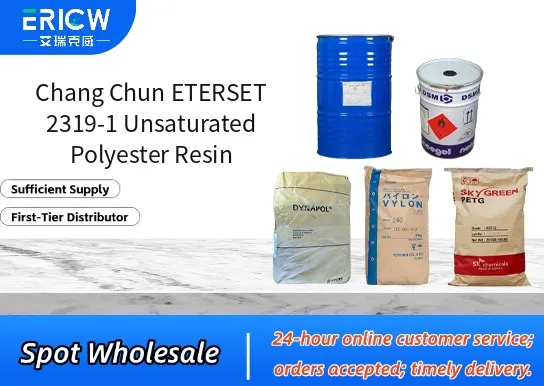
High reactivity with standard MEKP initiators for rapid gelation and efficient production cycles.
Excellent thixotropic behavior enabling superior fiber wet-out and reduced air entrapment in reinforced composites.
Good mechanical strength retention after post-cure, especially in flexural and impact performance.
Low styrene emission profile compliant with modern VOC-reduction requirements in industrial processing.
Consistent batch-to-batch reproducibility ensured by Chang Chun’s ISO 9001-certified manufacturing control.
Fiberglass-reinforced plastic (FRP) tanks and chemical storage vessels.
Marine deck components and non-structural hull laminates.
Architectural cladding panels and decorative GRP profiles.
Industrial grating and corrosion-resistant walkways.
Automotive under-hood non-critical composite housings.
| Chemical Type | Orthophthalic unsaturated polyester resin |
| Product Form | Liquid, ready-to-use |
| Appearance | Clear to pale yellow viscous liquid |
| Viscosity (25°C, mPa·s) | 450–650 |
| Reactive Diluent | Styrene (35–38 wt%) |
| Solid Content (wt%) | 62–65 |
| Density (25°C, g/cm³) | 1.11–1.13 |
| Primary Applications | Hand lay-up, spray-up, and centrifugal casting processes |
Q1: What is the primary application profile of ETERSET 2319-1?
A: ETERSET 2319-1 is formulated for high-performance laminating and casting applications in fiber-reinforced composites, particularly where excellent mechanical strength, low shrinkage, and good surface finish are required — commonly used in marine parts, industrial tanks, and semi-structural panels.
Q2: Which curing agents are typically recommended for this resin?
A: Standard methyl ethyl ketone peroxide (MEKP) initiators are widely compatible; cure speed and final properties can be adjusted using low-temperature or high-temperature MEKP variants depending on processing conditions and ambient requirements.
Q3: How does ETERSET 2319-1 compare to general-purpose unsaturated polyester resins in terms of viscosity and handling?
A: It exhibits a moderately low to medium viscosity at room temperature, offering improved wet-out of fiberglass reinforcements and easier pumpability compared to higher-viscosity structural grades — without requiring excessive dilution with styrene.
Q4: Is ETERSET 2319-1 suitable for outdoor applications exposed to UV and weathering?
A: While the base resin offers inherent resistance to moisture and thermal cycling, long-term UV stability requires integration with appropriate UV absorbers and pigment systems — it is not inherently UV-stable in unpigmented or clear formulations.
Contact With Us:
E-mail: wangxingqiang@ericwchem.com
Have a Questions? Call Us:
Add:
Building A1, Jiete Industrial Park, Huangpu District, Guangzhou City, Guangdong Province, China