English
 Español
 tiếng việt
 русский
High-gloss, excellent flow and leveling for premium surface aesthetics.
Outstanding weather resistance and UV stability for long-term outdoor performance.
Good chemical resistance to solvents, cleaning agents, and mild acids.
Optimized reactivity for efficient curing with TGIC-free or TGIC-based crosslinkers.
Consistent batch-to-batch quality and low volatile organic content (VOC).
Architectural aluminum extrusions (e.g., window frames, curtain walls).
Automotive exterior trim and non-structural components.
Outdoor furniture and garden equipment coatings.
Electrical enclosures and industrial metal housings.
| Chemical Type | Carboxyl-functional saturated polyester |
| Product Form | Free-flowing granular solid |
| Appearance | White to off-white granules |
| Acid Value (mg KOH/g) | 28–32 |
| Molecular Weight (Mn, GPC) | ~2,800–3,200 |
| Glass Transition Temperature (°C) | 68–72 |
| Primary Applications | Thermosetting powder coatings for architectural and industrial use |
| Key Features | High gloss, weather durability, TGIC-compatible, low melt viscosity |
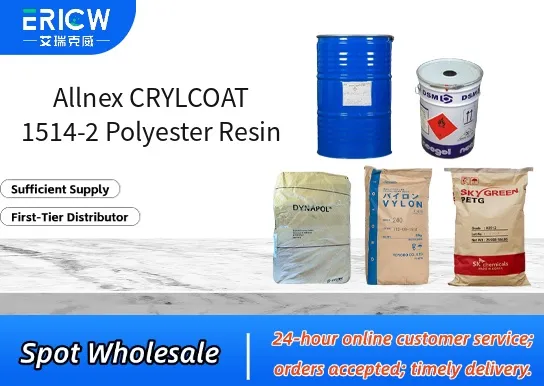
Q1: What is the primary application of CRYLCOAT 1514-2 in powder coatings?
A: CRYLCOAT 1514-2 is a carboxyl-functional polyester resin specifically designed for use in TGIC-free, high-gloss, decorative powder coating systems—particularly where excellent flow, leveling, and long-term weather resistance are required.
Q2: Is CRYLCOAT 1514-2 compatible with standard epoxy-based curing agents?
A: No—CRYLCOAT 1514-2 is formulated for use with hydroxyl-reactive crosslinkers such as beta-hydroxyalkylamide (HAA) systems, not epoxy resins. Its carboxyl functionality makes it incompatible with epoxy-based curing chemistries.
Q3: How does CRYLCOAT 1514-2 perform under outdoor exposure conditions?
A: This resin delivers robust UV stability and chalk resistance in exterior applications, supporting high-performance architectural and industrial finishes that maintain gloss and color retention over extended service life.
Q4: Can CRYLCOAT 1514-2 be blended with other polyester resins to modify performance?
A: Yes—formulators commonly blend CRYLCOAT 1514-2 with complementary polyesters to fine-tune properties such as cure response, film hardness, flexibility, or weathering behavior, provided compatibility and stoichiometric balance are verified during development.
Contact With Us:
E-mail: wangxingqiang@ericwchem.com
Have a Questions? Call Us:
Add:
Building A1, Jiete Industrial Park, Huangpu District, Guangzhou City, Guangdong Province, China