English
 Español
 tiếng việt
 русский
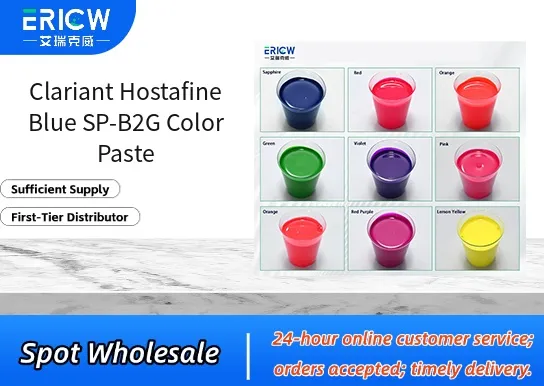
High chroma, clean blue shade with excellent batch-to-batch color consistency.
Optimized for low-viscosity aqueous systems with outstanding dispersion stability.
Excellent lightfastness and weather resistance suitable for demanding outdoor applications.
Low heavy metal content, compliant with major global regulatory frameworks including EU REACH and US CPSIA.
Compatible with common water-based acrylic, styrene-acrylic, and PVA emulsion binders.
Architectural interior and exterior wall paints.
Water-based industrial maintenance coatings.
Wood coatings for furniture and cabinetry.
Printing inks for packaging and labeling (water-based flexo & gravure).
Construction adhesives and cementitious tile grouts.
| Chemical Type | Organic pigment dispersion (C.I. Pigment Blue 15:3) |
| Product Form | Concentrated aqueous color paste |
| Appearance | Homogeneous, viscous blue liquid with slight gloss |
| pH (25°C) | 7.5 – 8.5 |
| Non-Volatile Content (wt%) | 38 – 42 |
| Density (20°C) | 1.12 – 1.16 g/cm³ |
| Viscosity (Brookfield LVT, Spindle #3, 20 rpm, 25°C) | 8,000 – 12,000 mPa·s |
| Primary Applications | Water-based architectural and industrial coatings |
Q1: What is the primary application field for Hostafine Blue SP-B2G Color Paste?
A: Hostafine Blue SP-B2G is primarily formulated for coloring polyolefin-based plastics—especially PP and HDPE—in applications requiring high thermal stability, excellent dispersion, and good lightfastness, such as automotive interior components, technical parts, and durable consumer goods.
Q2: Is this color paste suitable for food-contact plastic applications?
A: Hostafine Blue SP-B2G is designed for non-food-contact industrial applications. It is not certified for direct or indirect food contact under major global regulatory frameworks unless explicitly validated and approved by the end-user’s regulatory team in accordance with their specific formulation and processing conditions.
Q3: How should the paste be incorporated into polyolefin compounds?
A: The paste is typically introduced via masterbatch dilution or direct addition during compounding—using twin-screw extrusion or high-shear mixing. Good dispersion is achieved at standard polyolefin processing temperatures (180–240 °C), and pre-drying is generally not required due to its low moisture sensitivity.
Q4: Does Hostafine Blue SP-B2G offer resistance to migration in polymer blends?
A: Yes, it demonstrates low tendency to migrate in compatible polyolefin matrices under typical service conditions, owing to its optimized molecular structure and high compatibility with non-polar polymers. Migration performance may vary in polar blends or under extreme thermal or solvent exposure.
Q5: What is the recommended dosage range for achieving standard blue shades?
A: Dosage depends on the target shade strength and base polymer opacity, but typical usage ranges from 0.1% to 2% by weight relative to the final compound. Lower concentrations are often sufficient for medium-to-light shades, while deeper tones may require higher loadings—always verified through lab-scale trials.
Contact With Us:
E-mail: wangxingqiang@ericwchem.com
Have a Questions? Call Us:
Add:
Building A1, Jiete Industrial Park, Huangpu District, Guangzhou City, Guangdong Province, China