English
 Español
 tiếng việt
 русский
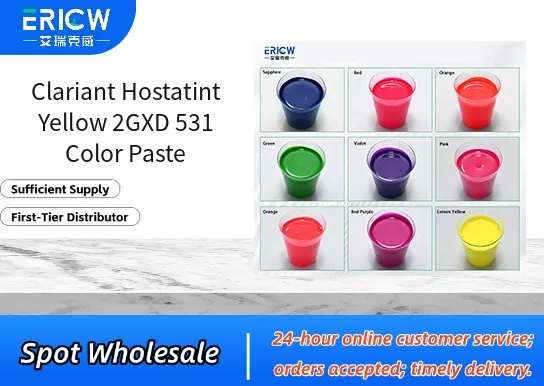
High chroma, clean yellow shade with excellent lightfastness for durable color performance.
Optimized rheology for easy dispersion and stable incorporation into water-based systems.
Low volatile organic compound (VOC) content, supporting sustainable formulation requirements.
Good compatibility with common acrylic, styrene-acrylic, and vinyl acetate-based binders.
Consistent batch-to-batch color strength and hue, ensuring reliable production repeatability.
Architectural coatings including interior and exterior wall paints.
Industrial maintenance coatings for metal and concrete substrates.
Wood coatings such as stains, primers, and clear topcoats.
Plastic coatings and coil coatings requiring high-color-stability pigmentation.
| Chemical Type | Azo pigment dispersion in aqueous medium |
| Product Form | Liquid color paste |
| Appearance | Homogeneous, viscous yellow suspension |
| Primary Applications | Water-based architectural and industrial coatings |
| Key Features | High tinctorial strength, low dusting, non-settling |
| Benefits | Reduced formulation time, improved color consistency, simplified handling |
| pH (10% aqueous dilution) | 7.5 – 9.0 |
| Specific Gravity (20 °C) | 1.15 – 1.25 g/cm³ |
Q1: What is the primary application area for Hostatint Yellow 2GXD 531 Color Paste?
A: This pigment paste is specifically developed for coloring polyolefin-based packaging materials, including flexible films and rigid containers, where high thermal stability and good dispersion performance are required during extrusion and thermoforming processes.
Q2: Is Hostatint Yellow 2GXD 531 suitable for food-contact applications?
A: Yes — it is formulated to meet global regulatory expectations for indirect food contact in polyolefins, subject to compliance with applicable regional requirements and final formulation validation by the end user.
Q3: How should this color paste be incorporated into polyolefin compounds?
A: It is typically added directly during compounding via side-feeding or gravimetric dosing systems. Good dispersion is achieved under standard melt processing conditions; pre-mixing with carrier resin is not required but may be considered for highly sensitive formulations.
Q4: What is the typical dosage range for achieving target shade intensity?
A: Dosage depends on the base polymer, desired opacity, and processing method, but generally ranges from 0.1% to 2% by weight — with most standard packaging applications falling between 0.3% and 1.0%.
Contact With Us:
E-mail: wangxingqiang@ericwchem.com
Have a Questions? Call Us:
Add:
Building A1, Jiete Industrial Park, Huangpu District, Guangzhou City, Guangdong Province, China