English
 Español
 tiếng việt
 русский
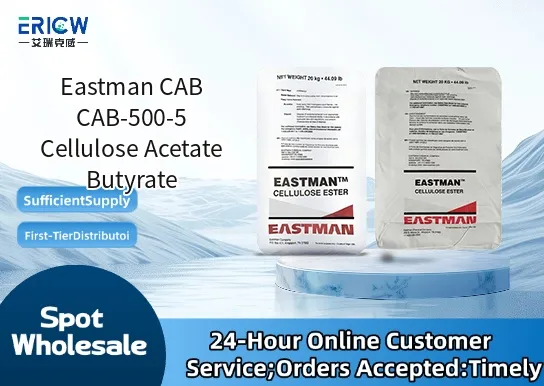
Excellent compatibility with a broad range of resins, plasticizers, and pigments—including acrylics, vinyls, epoxies, and nitrocellulose.
Superior toughness, flexibility, and impact resistance without requiring high levels of plasticizer.
Outstanding UV stability and weatherability, minimizing yellowing and gloss loss in outdoor applications.
Low moisture absorption compared to cellulose acetate, enhancing dimensional stability in humid environments.
Good thermal processability with melt flow suitable for extrusion, injection molding, and solution coating.
Automotive interior trim coatings and clear topcoats for enhanced mar and scratch resistance.
High-performance industrial maintenance coatings for metal and wood substrates.
Overprint varnishes and protective coatings for flexible packaging and premium labels.
Binders and film formers in water-based and solvent-based ink systems.
Thermoplastic components in consumer electronics housings and small appliance parts.
| Chemical Type | Cellulose acetate butyrate (CAB) |
| Product Form | Pellets |
| Appearance | White to off-white free-flowing pellets |
| Butyryl Content (wt%) | Approx. 48–51 |
| Acetyl Content (wt%) | Approx. 16–19 |
| Hydroxyl Content (wt%) | Approx. 2.5–3.5 |
| Typical Intrinsic Viscosity (dL/g) | 0.45–0.55 (in 6% w/w solution, 25°C, methyl ethyl ketone/toluene 60/40) |
| Primary Applications | Coatings, inks, thermoplastics, binders |
Contact With Us:
E-mail: wangxingqiang@ericwchem.com
Have a Questions? Call Us:
Add:
Building A1, Jiete Industrial Park, Huangpu District, Guangzhou City, Guangdong Province, China