English
 Español
 tiếng việt
 русский
Excellent abrasion resistance for extended service life in demanding mechanical environments.
High tensile strength and elongation at break, enabling reliable performance under dynamic stress.
Good low-temperature flexibility down to –30 °C without significant loss of elasticity.
Outstanding oil and grease resistance, maintaining integrity in contact with hydrocarbon-based fluids.
Processable via standard thermoplastic techniques including injection molding, extrusion, and blow molding.
Automotive interior trim components requiring soft-touch feel and durability.
Industrial hoses and tubing for fluid transfer in hydraulic and pneumatic systems.
Protective casings and overmolded grips for power tools and handheld equipment.
Wear-resistant conveyor belts and drive belts in material handling systems.
Seals and gaskets for general industrial equipment operating under moderate pressure and temperature.
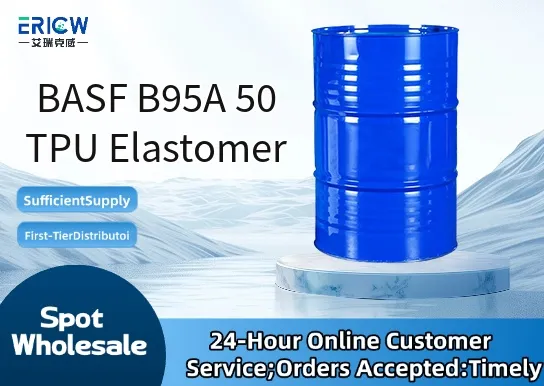
| Chemical Type | Thermoplastic Polyurethane (TPU), polyester-based |
| Product Form | Pellets |
| Appearance | Off-white to light beige, free-flowing granules |
| Shore A Hardness | 95 ± 2 |
| Density (g/cm³) | 1.18–1.22 |
| Melt Flow Index (230 °C / 2.16 kg) | 10–14 g/10 min |
| Primary Applications | Dynamic mechanical parts, protective overmolding, flexible tubing |
| Key Features | High elasticity, oil resistance, processability, low-temperature toughness |
Q1: What are the key processing advantages of BASF B95A 50 compared to conventional thermoplastic polyurethanes?
A: BASF B95A 50 offers enhanced melt stability and lower melt viscosity at processing temperatures, enabling smoother extrusion and injection molding—particularly beneficial for thin-walled or highly detailed parts. Its optimized thermal profile also supports shorter cycle times and reduced risk of thermal degradation during repeated processing.
Q2: Is B95A 50 suitable for applications requiring high abrasion resistance and dynamic mechanical performance?
A: Yes—B95A 50 is engineered to deliver excellent resistance to wear, cut, and tear under repeated flexing or sliding contact. Its balanced hard-segment content and phase separation behavior contribute to superior resilience and long-term fatigue performance in demanding dynamic applications such as industrial rollers, seals, and sporting goods components.
Q3: Can B95A 50 be overmolded onto common engineering plastics like PP, ABS, or PC?
A: B95A 50 demonstrates good adhesion to several polar substrates—including PC and ABS—when processed under appropriate temperature and mold surface conditions. Bond strength to non-polar polymers like PP typically requires surface pretreatment (e.g., flame or plasma) or use of a functionalized tie-layer for reliable structural overmolding.
Q4: How does moisture sensitivity affect handling and processing of B95A 50?
A: As with most polyester-based TPUs, B95A 50 is hygroscopic and must be dried prior to processing. Recommended drying conditions are typically 80–90 °C for 2–4 hours using desiccant-assisted dryers. Inadequate drying may lead to surface defects, reduced mechanical properties, or hydrolytic instability during high-temperature processing.
Contact With Us:
E-mail: wangxingqiang@ericwchem.com
Have a Questions? Call Us:
Add:
Building A1, Jiete Industrial Park, Huangpu District, Guangzhou City, Guangdong Province, China