English
 Español
 tiếng việt
 русский
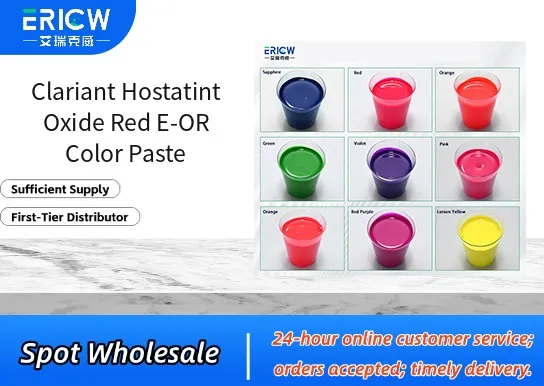
Highly concentrated iron oxide-based pigment dispersion for efficient coloration.
Excellent lightfastness and weather resistance suitable for outdoor applications.
Optimized rheology for easy incorporation into water-based systems without additional grinding.
Low volatile organic compound (VOC) content, supporting sustainable formulation requirements.
Consistent batch-to-batch color strength and hue stability ensured by strict Clariant quality control.
Architectural coatings including interior and exterior wall paints.
Cementitious products such as colored mortars, renders, and concrete pavers.
Water-based industrial finishes for metal and wood substrates.
Plaster and stucco systems requiring durable red oxide shading.
Tile grouts and joint fillers where alkali resistance is critical.
| Chemical Type | Iron oxide (Fe₂O₃) pigment dispersion |
| Product Form | Ready-to-use aqueous color paste |
| Appearance | Viscous, homogeneous red paste |
| Primary Applications | Water-based architectural coatings, cementitious materials |
| Key Features | Alkali-stable, non-bleeding, low dusting |
| Benefits | Reduced formulation time, improved color consistency, enhanced UV resistance |
| pH (10% in water) | 7.5 – 8.5 |
| Storage Stability | 12 months unopened at 5–30 °C |
Q1: What is the primary application field for Hostatint Oxide Red E-OR Color Paste?
A: This pigment paste is specifically developed for coloring polyolefin compounds—especially PP and PE—used in injection molding, blow molding, and extrusion applications where high thermal stability and good dispersion are required.
Q2: Is this product suitable for food-contact plastics?
A: Hostatint Oxide Red E-OR Color Paste is formulated to meet general requirements for food-contact applications in polyolefins, subject to final regulatory review and compliance verification by the compounder or end user under applicable regional legislation.
Q3: How should this paste be incorporated into polymer melts?
A: It is typically introduced via masterbatch dilution or direct addition during compounding. Good melt mixing and sufficient residence time are recommended to ensure uniform dispersion and optimal color development.
Q4: Does this color paste offer resistance to migration and blooming in finished parts?
A: Yes—the oxide-based pigment system and optimized carrier formulation provide excellent compatibility with polyolefins, minimizing tendencies toward migration, blooming, or surface efflorescence under standard processing and service conditions.
Q5: What is the typical dosage range when using this paste in polyolefin compounds?
A: Dosage depends on the desired shade intensity and base polymer characteristics, but it is generally used at low concentrations—typically ranging from 0.1% to 2% by weight of the final compound.
Contact With Us:
E-mail: wangxingqiang@ericwchem.com
Have a Questions? Call Us:
Add:
Building A1, Jiete Industrial Park, Huangpu District, Guangzhou City, Guangdong Province, China