English
 Español
 tiếng việt
 русский
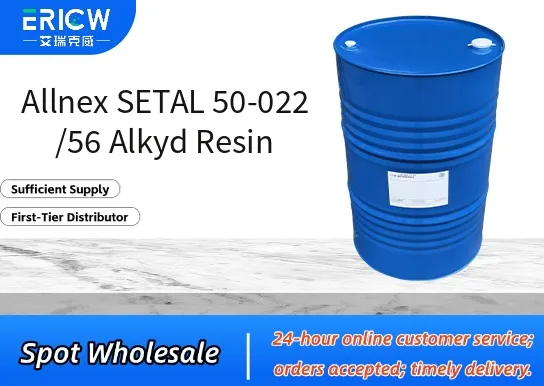
Medium-oil-length alkyd resin offering balanced drying speed and film flexibility.
Excellent compatibility with nitrocellulose, vinyls, and other common coating resins.
Good gloss retention and color stability in air-drying decorative finishes.
Low volatile organic compound (VOC) formulation support for compliant architectural and industrial coatings.
Consistent batch-to-batch performance ensured by Allnex’s stringent quality control protocols.
Interior and exterior architectural enamels for wood and metal substrates.
Air-drying maintenance coatings for industrial equipment and infrastructure.
Decorative varnishes and clear topcoats requiring high clarity and smooth leveling.
Repair and touch-up paints where recoatability and sandability are critical.
General-purpose solvent-borne protective coatings for mild environmental exposure.
| Chemical Type | Medium-oil modified alkyd resin |
| Product Form | Liquid, solvent-borne solution |
| Appearance | Clear to pale yellow viscous liquid |
| Primary Applications | Architectural enamels, maintenance coatings, varnishes |
| Key Features | Good drying speed, flexibility, gloss retention, resin compatibility |
| Benefits | Easy formulation, reliable film formation, VOC-reduction enabler |
| Solvent System | Aromatic hydrocarbons (e.g., xylene, Solvesso™ 100) |
| Storage Stability | Stable for ≥12 months at 15–30°C in sealed containers |
Q1: What is the primary application area for SETAL 50-022/56?
A: SETAL 50-022/56 is a medium-oil-length alkyd resin designed primarily for solvent-borne decorative and protective coatings, including interior and exterior architectural paints, wood finishes, and general-purpose industrial maintenance coatings where balanced drying, gloss retention, and film flexibility are required.
Q2: Is SETAL 50-022/56 compatible with common crosslinkers used in baking systems?
A: Yes — this alkyd resin contains hydroxyl functionality and is formulated to be compatible with standard amino resins (e.g., melamine-formaldehyde) in thermosetting systems. It performs well in low-bake and ambient-cure formulations, though optimal cure conditions depend on the full formulation matrix and substrate.
Q3: How does SETAL 50-022/56 compare to high-solids alkyds in terms of VOC contribution?
A: As a conventional medium-oil alkyd, SETAL 50-022/56 is typically supplied at moderate solids content and requires standard aromatic or aliphatic solvents. It is not classified as a high-solids or low-VOC resin; formulators seeking reduced VOC should consider it as part of a broader system optimization rather than a drop-in low-VOC solution.
Q4: Can SETAL 50-022/56 be blended with acrylic or polyester resins?
A: Yes — it demonstrates good compatibility with many acrylic and saturated polyester resins in solvent-borne systems, enabling hybrid formulations that leverage improved weather resistance or mechanical properties. Compatibility testing under actual formulation conditions is recommended to confirm stability and performance.
Contact With Us:
E-mail: wangxingqiang@ericwchem.com
Have a Questions? Call Us:
Add:
Building A1, Jiete Industrial Park, Huangpu District, Guangzhou City, Guangdong Province, China