English
 Español
 tiếng việt
 русский
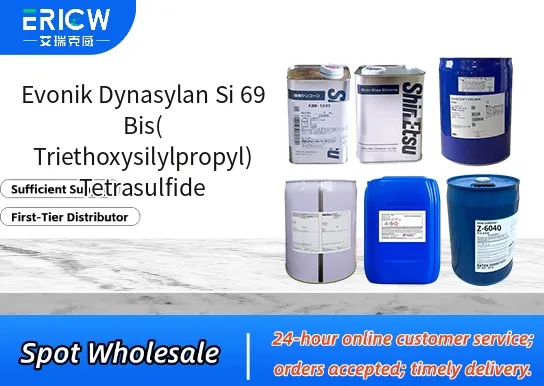
Enhances adhesion between inorganic fillers (e.g., silica, silicates) and organic polymer matrices in rubber and thermoplastics.
Acts as a bifunctional coupling agent with hydrolyzable triethoxysilyl groups and a reactive tetrasulfide bridge for covalent bonding to sulfur-cured elastomers.
Improves mechanical properties including tensile strength, tear resistance, and dynamic fatigue performance in high-performance tires and industrial rubber goods.
Reduces filler-filler interaction (Payne effect), enabling lower rolling resistance and improved wet grip in silica-reinforced tread compounds.
Offers excellent hydrolytic stability in formulated masterbatches due to its controlled reactivity and shelf-life compatibility.
Silica-reinforced passenger and truck tire treads for high-performance and fuel-efficient compounds.
Industrial rubber products including conveyor belts, hoses, and vibration dampers requiring enhanced filler-polymer coupling.
Dynamic rubber components such as engine mounts and bushings where low heat build-up and long-term durability are critical.
Specialty elastomer formulations using precipitated silica, fumed silica, or other silicate-based fillers.
Thermoplastic vulcanizates (TPVs) and thermoplastic elastomers (TPEs) incorporating silica or glass fibers.
| Chemical Type | Bis(triethoxysilylpropyl) tetrasulfide coupling agent |
| Product Form | Liquid |
| Appearance | Pale yellow to amber clear liquid |
| Density (20 °C) | 1.18–1.20 g/cm³ |
| Refractive Index (20 °C) | 1.495–1.505 |
| Flash Point (PMCC) | ≥ 110 °C |
| Sulfur Content | ~15.5–16.5 wt% |
| Primary Applications | Silica coupling in sulfur-cured elastomers, especially tires and industrial rubber |
Contact With Us:
E-mail: wangxingqiang@ericwchem.com
Have a Questions? Call Us:
Add:
Building A1, Jiete Industrial Park, Huangpu District, Guangzhou City, Guangdong Province, China