English
 Español
 tiếng việt
 русский
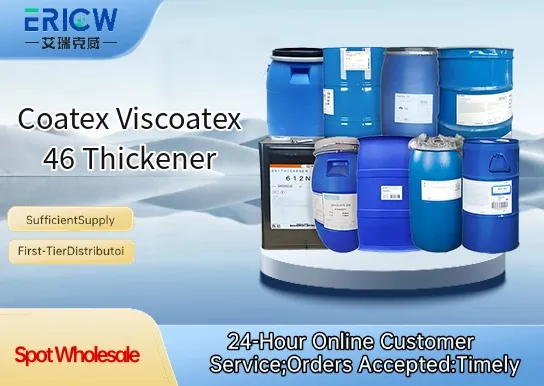
Non-ionic associative thickener delivering excellent rheology control in waterborne systems.
Provides outstanding sag resistance and leveling balance in architectural and industrial coatings.
Compatible with a broad range of surfactants, co-thickeners, and biocides.
Enables low-shear viscosity enhancement without compromising high-shear flow properties.
Stable across pH range 4–10 and tolerant to moderate electrolyte levels.
Interior and exterior architectural flat and low-sheen paints.
Waterborne industrial maintenance coatings.
Textile printing pastes requiring pseudoplastic behavior.
Adhesives and construction sealants where controlled viscosity and anti-drip performance are critical.
Wood and metal primers formulated for brush/roller application.
| Chemical Type | Non-ionic hydrophobically modified ethoxylated urethane (HEUR) |
| Product Form | Clear to slightly hazy aqueous liquid |
| Appearance | Colorless to pale yellow viscous liquid |
| Active Content (w/w %) | 35–38% |
| pH (1% aqueous solution) | 6.5–8.5 |
| Viscosity (25°C, Brookfield RVT, spindle #3, 20 rpm) | 1,500–3,500 mPa·s |
| Primary Applications | Architectural coatings, industrial waterborne coatings, adhesives |
| Key Features | Rheology modifier, sag resistance, leveling aid, shear-thinning profile |
Q1: What type of rheology does Viscoatex 46 provide in waterborne systems?
A: Viscoatex 46 is a hydrophobically modified ethoxylated urethane (HEUR) thickener that delivers pronounced pseudoplastic (shear-thinning) behavior, supporting excellent sag resistance at rest and good flow/leveling during application.
Q2: Is Viscoatex 46 compatible with anionic and nonionic surfactants commonly used in architectural coatings?
A: Yes — Viscoatex 46 exhibits broad compatibility with common anionic and nonionic surfactants, though optimal performance is achieved when added after surfactants and other water-soluble components to avoid premature micellization or viscosity loss.
Q3: How should Viscoatex 46 be incorporated into a formulation to ensure consistent thickening performance?
A: It is recommended to dilute Viscoatex 46 with water or a compatible co-solvent prior to addition, and then incorporate it under moderate shear near the end of the let-down stage — typically after pigments, fillers, and primary thickeners — to maximize associative network formation.
Q4: Does Viscoatex 46 offer resistance to microbial degradation?
A: As a synthetic polymeric thickener, Viscoatex 46 itself is not a nutrient source for microorganisms and does not require additional biocides for stability — however, its aqueous formulations still require appropriate preservation depending on raw material composition and storage conditions.
Q5: Can Viscoatex 46 be used in low-VOC or zero-VOC coating systems?
A: Yes — Viscoatex 46 contains no added VOCs and is well-suited for low- and zero-VOC architectural and industrial waterborne coatings where high-performance rheology control is required without compromising regulatory compliance.
Contact With Us:
E-mail: wangxingqiang@ericwchem.com
Have a Questions? Call Us:
Add:
Building A1, Jiete Industrial Park, Huangpu District, Guangzhou City, Guangdong Province, China