English
 Español
 tiếng việt
 русский
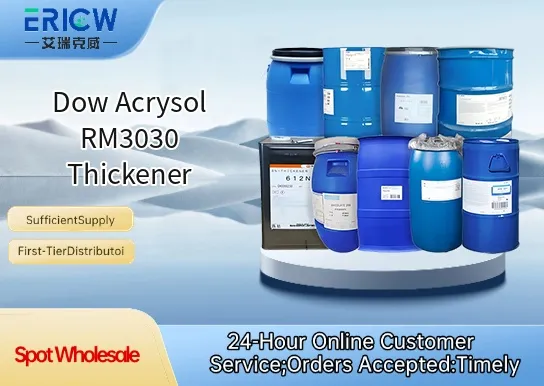
High-efficiency associative thickener delivering excellent rheology control in waterborne systems.
Provides outstanding sag resistance and brush/roller application performance in architectural coatings.
Compatible with a broad range of surfactants, pigments, and co-thickeners including cellulose ethers and polyacrylates.
Enables low-shear viscosity build without compromising high-shear flow, supporting spray and roll application efficiency.
Stable across pH 4–12, offering robust formulation flexibility and compatibility with common neutralization agents.
Interior and exterior latex paints for residential and commercial use.
Low-VOC and zero-VOC architectural coatings requiring high-performance rheology modifiers.
Textured finishes and heavy-bodied decorative coatings.
Water-based primers and undercoats with demanding anti-settling and leveling requirements.
Industrial maintenance coatings where balanced viscosity and spatter resistance are critical.
| Chemical Type | Hydrophobically modified ethoxylated urethane (HEUR) |
| Product Form | Aqueous dispersion |
| Appearance | Opaque white to off-white liquid |
| pH (as received, 25°C) | 6.0 – 8.0 |
| Active Content (wt%) | 30.0 ± 1.0% |
| Viscosity (Brookfield RVT, spindle #3, 20 rpm, 25°C) | 5,000 – 15,000 cP |
| Freeze-Thaw Stability | Passes 3 cycles (-18°C × 16 h / 25°C × 8 h) |
| Primary Applications | Architectural waterborne coatings, industrial maintenance coatings |
Q1: What type of rheology does RM3030 provide in waterborne formulations?
A: RM3030 is a hydrophobically modified ethoxylated urethane (HEUR) associative thickener that delivers strong pseudoplastic (shear-thinning) flow behavior, providing excellent sag resistance at rest and good application properties under shear.
Q2: Is RM3030 compatible with high-shear mixing and common paint manufacturing processes?
A: Yes — RM3030 is designed for robust performance during high-shear dispersion and post-addition in both let-down and mill-base stages. It exhibits good stability in the presence of surfactants, co-solvents, and typical pigment dispersants used in architectural and industrial coatings.
Q3: How should RM3030 be added to a formulation for optimal performance?
A: RM3030 is typically added as a post-additive to the finished formulation, either neat or pre-diluted with water or compatible solvent. For best results, add slowly with moderate agitation and allow sufficient time for full associative network development before final viscosity adjustment or packaging.
Q4: Does RM3030 require pH adjustment or neutralization prior to use?
A: No — unlike alkali-swellable thickeners (ASE), RM3030 is non-ionic and functions independently of pH. It performs consistently across a broad pH range (typically pH 4–10) without requiring neutralization or buffering agents.
Q5: What are key handling and storage recommendations for RM3030?
A: Store in original sealed containers at temperatures between 5 °C and 30 °C, protected from freezing and prolonged exposure to direct sunlight. Avoid contamination during handling, and ensure equipment is clean and free of incompatible residues before use.
Contact With Us:
E-mail: wangxingqiang@ericwchem.com
Have a Questions? Call Us:
Add:
Building A1, Jiete Industrial Park, Huangpu District, Guangzhou City, Guangdong Province, China