English
 Español
 tiếng việt
 русский
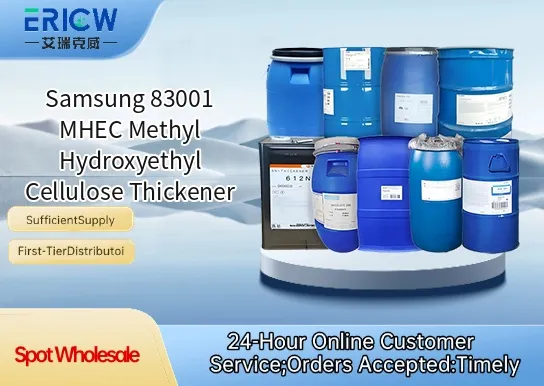
Excellent water solubility and rapid dispersion without lumping in cold water.
High thickening efficiency with stable viscosity across pH 3–11 range.
Outstanding thermal stability—maintains rheological performance up to 90°C.
Low salt sensitivity, ensuring consistent performance in electrolyte-containing formulations.
Non-ionic character provides compatibility with anionic, cationic, and non-ionic surfactants.
Water-based architectural coatings and interior/exterior paints.
Cement-based tile adhesives and self-leveling underlayments.
Oilfield drilling fluids and completion fluids requiring shear-thinning behavior.
Pharmaceutical suspensions and topical gels requiring non-ionic, GRAS-compatible thickeners.
Industrial cleaning formulations including heavy-duty degreasers and liquid detergents.
| Chemical Type | Methyl Hydroxyethyl Cellulose (MHEC) |
| Product Form | White to off-white free-flowing powder |
| Appearance | Odorless, fine granular powder |
| Viscosity (1% aqueous solution, 20°C) | Approx. 8,000–12,000 mPa·s |
| pH (1% solution) | 6.0–8.5 |
| Moisture Content (by weight) | ≤5.0% |
| Solubility | Fully soluble in cold water; insoluble in organic solvents |
| Primary Applications | Thickener, rheology modifier, and water retention agent |
Q1: What is the primary functional role of Samsung 83001 MHEC in water-based formulations?
A: Samsung 83001 MHEC functions primarily as a non-ionic rheology modifier and thickener. It provides excellent viscosity development, shear-thinning behavior, and suspension stabilization in aqueous systems—especially where compatibility with electrolytes and broad pH stability are required.
Q2: How does Samsung 83001 MHEC differ from standard HEC or MC thickeners?
A: The dual substitution with both methyl and hydroxyethyl groups enhances water solubility, improves salt tolerance, and offers superior thermal gelation resistance compared to conventional HEC or methylcellulose (MC). This makes it particularly suitable for demanding applications such as high-solids architectural coatings or cementitious mortars exposed to variable ambient conditions.
Q3: Is Samsung 83001 MHEC compatible with biocides and other common additives used in paint and coating formulations?
A: Yes, Samsung 83001 MHEC demonstrates good compatibility with a wide range of preservatives, defoamers, dispersants, and co-thickeners. Its non-ionic nature minimizes interactions with ionic surfactants or antimicrobial agents, supporting stable formulation performance over shelf life.
Q4: What is the typical dosage range for effective thickening in architectural coatings?
A: Dosage depends on formulation requirements and desired rheological profile, but Samsung 83001 MHEC is typically used at low concentrations—generally ranging from 0.1% to 2% by weight of the total formulation—to achieve target viscosity and sag resistance without compromising flow or leveling.
Contact With Us:
E-mail: wangxingqiang@ericwchem.com
Have a Questions? Call Us:
Add:
Building A1, Jiete Industrial Park, Huangpu District, Guangzhou City, Guangdong Province, China