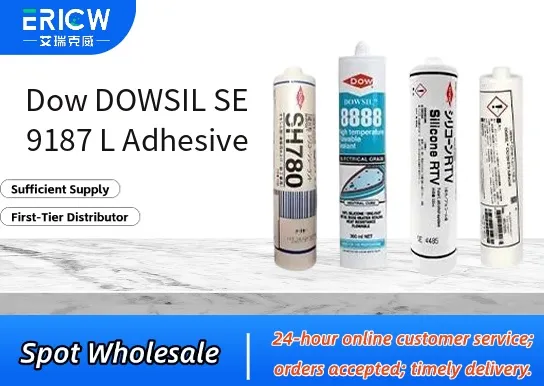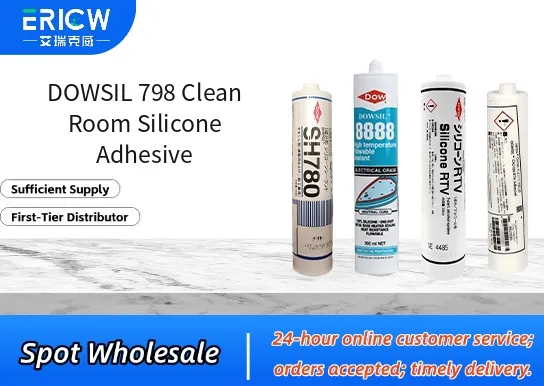
Ultra-low ionic and metallic impurity content, meeting stringent ISO Class 1–5 cleanroom requirements.
Acetoxy-cure silicone chemistry enabling rapid room-temperature cure with minimal volatile byproducts.
Excellent adhesion to glass, stainless steel, anodized aluminum, and common cleanroom plastics without primer.
Non-corrosive to sensitive electronic components and optical surfaces after full cure.
Compliant with SEMI F57 and ASTM D3405 standards for semiconductor-grade sealants.
Sealing and bonding of HEPA/ULPA filter frames in pharmaceutical and biotech cleanrooms.
Assembly of wafer handling fixtures and photomask storage cabinets in semiconductor fabrication facilities.
Mounting of precision optics and sensors in analytical instrumentation used in controlled environments.
Bonding of laminar flow hood components and glovebox viewports requiring particle-free integrity.
| Chemical Type | Acetoxy-curing silicone polymer |
| Product Form | Thixotropic paste, single-component |
| Appearance | Off-white, uniform paste |
| Primary Applications | Cleanroom sealing, bonding, and gasketing |
| Key Features | Low outgassing, non-corrosive, ultra-low sodium/potassium/chloride |
| Benefits | Minimizes particle generation and surface contamination in critical environments |
| Cure Mechanism | Moisture-cured at ambient temperature |
| Storage Stability | 12 months unopened at 5–25°C |
Q1: What makes DOWSIL 798 suitable for cleanroom environments?
A: DOWSIL 798 is formulated to deliver ultra-low extractables and minimal volatile organic compound (VOC) release during cure, supporting compliance with stringent particulate and molecular contamination control requirements typical of ISO Class 5–7 cleanrooms. Its neutral-cure chemistry avoids corrosive by-products like acetic acid, reducing risk to sensitive substrates and equipment.
Q2: Can DOWSIL 798 be used for bonding glass or quartz components in semiconductor tooling?
A: Yes — DOWSIL 798 offers excellent adhesion to high-purity glass, fused quartz, and polished stainless steel without primers under controlled cleanroom conditions. Its low-outgassing profile and thermal stability up to 200 °C make it well-suited for static bonding applications in vacuum-compatible and plasma-resistant assemblies.
Q3: How does humidity affect the cure performance of DOWSIL 798?
A: As a moisture-cure silicone, DOWSIL 798 requires ambient atmospheric moisture to initiate and progress curing. Cure speed increases with relative humidity (RH), though it remains functional across a broad RH range (30–70%). In low-humidity cleanrooms, extended tack-free time and full cure duration should be anticipated; post-application conditioning at controlled RH may be recommended for consistent throughput.
Q4: Is DOWSIL 798 compatible with automated dispensing systems?
A: Yes — its thixotropic consistency and stable rheology support reliable metering and dispensing via standard positive-displacement or time/pressure systems. It exhibits minimal slumping after deposition and maintains edge definition on vertical surfaces, enabling precise bead control for micro-assembly and gasketing tasks.
Contact With Us:
E-mail: wangxingqiang@ericwchem.com
Have a Questions? Call Us:
Add:
Building A1, Jiete Industrial Park, Huangpu District, Guangzhou City, Guangdong Province, China
 English
 Español
 tiếng việt
 русский