English
 Español
 tiếng việt
 русский
High-gloss, durable film formation with excellent leveling and flow characteristics.
Optimized for ambient-cure applications with balanced drying speed and extended pot life.
Good compatibility with common solvents, pigments, and co-resins including acrylics and melamines.
Enhanced weather resistance and UV stability compared to conventional short-oil alkyds.
Low volatile organic compound (VOC) content, supporting compliant architectural and industrial coating formulations.
High-performance decorative wood coatings for interior and exterior furniture.
Protective metal coatings for agricultural and construction equipment.
Industrial maintenance coatings for machinery and structural steel.
Refinish coatings in automotive and marine OEM-adjacent applications.
General-purpose solvent-borne industrial enamels requiring gloss retention and hardness.
| Chemical Type | Short-oil modified alkyd resin |
| Product Form | Liquid |
| Appearance | Clear to pale yellow viscous liquid |
| Primary Applications | Decorative and protective solvent-borne coatings |
| Key Features | High gloss, fast through-dry, good sandability |
| Benefits | Improved formulation flexibility and reduced energy consumption during curing |
| Solubility | Compatible with aromatic and aliphatic hydrocarbons, ketones, and esters |
| VOC Content (as supplied) | Approx. 580 g/L (typical) |
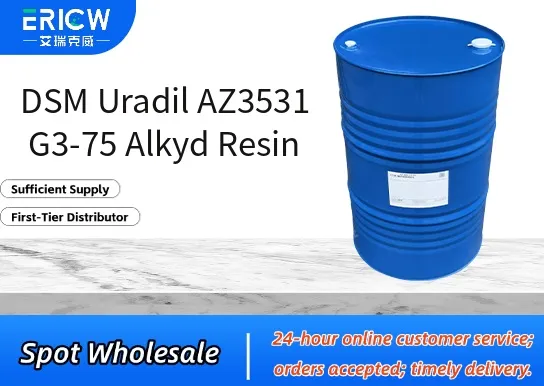
Q1: What is the primary function of Uradil AZ3531 G3-75 in alkyd-based coatings?
A: Uradil AZ3531 G3-75 functions as a reactive urethane-modified alkyd resin, enhancing film hardness, gloss retention, and through-dry performance while maintaining compatibility with conventional alkyd solvents and co-resins.
Q2: Is AZ3531 G3-75 suitable for air-drying or forced-dry applications?
A: It is formulated for both ambient-air drying and accelerated forced-dry conditions—offering improved early hardness development compared to standard long-oil alkyds, particularly in industrial maintenance and wood finishing systems.
Q3: How does this resin compare to unmodified alkyds in terms of yellowing resistance?
A: As a urethane-modified alkyd, AZ3531 G3-75 exhibits significantly improved resistance to yellowing under UV exposure and thermal aging versus traditional cobalt-catalyzed alkyds—making it well-suited for light-colored and clear topcoats.
Q4: Can AZ3531 G3-75 be blended with other resins such as acrylics or melamines?
A: Yes—it demonstrates good compatibility with hydroxyl-functional acrylics, melamine-formaldehydes, and certain polyisocyanates when used in hybrid or crosslinkable systems, though compatibility testing under end-use conditions is recommended.
Q5: What solvent systems are typically recommended for diluting AZ3531 G3-75?
A: It is fully soluble in common aromatic and aliphatic hydrocarbon solvents—including xylene, Solvesso™ 100, and high-flash naphthas—and may also be diluted with esters like butyl acetate, depending on formulation volatility and regulatory requirements.
Contact With Us:
E-mail: wangxingqiang@ericwchem.com
Have a Questions? Call Us:
Add:
Building A1, Jiete Industrial Park, Huangpu District, Guangzhou City, Guangdong Province, China