English
 Español
 tiếng việt
 русский
Excellent soft-touch feel with balanced elasticity and recovery
Good processability on standard injection molding and extrusion equipment
Enhanced compatibility with polypropylene (PP) and polyethylene (PE) substrates
Low extractables and compliant with FDA 21 CFR §177.2600 for food-contact applications
Halogen-free formulation meeting RoHS and REACH regulatory requirements
Soft-grip overmolding for power tools and hand-held appliances
Sealing rings and gaskets in automotive interior components
Flexible hinges and living hinges in consumer electronics housings
Food-grade squeeze bottles and dispensing caps
Medical device grips and non-sterile wearable component housings
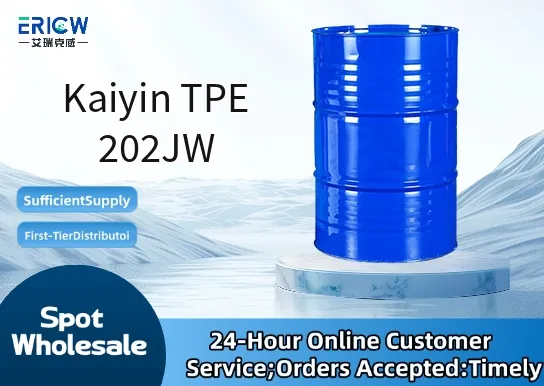
| Chemical Type | Thermoplastic Elastomer (TPE), SEBS-based |
| Product Form | Pellets |
| Appearance | Off-white to light beige, free-flowing granules |
| Hardness (Shore A) | 25 ± 3 |
| Melt Flow Rate (230°C/2.16 kg) | 18–22 g/10 min |
| Density | 0.90–0.92 g/cm³ |
| Key Features | Soft-touch, PP/PE adhesion, low compression set |
| Benefits | Reduced cycle time, no pre-drying required, recyclable |
Q1: What is Kaiyin TPE 202JW primarily used for?
A: Kaiyin TPE 202JW is a thermoplastic elastomer modifier designed to enhance flexibility, resilience, and processability in rigid thermoplastic compounds—especially polypropylene (PP) and polyethylene (PE) blends. It is commonly applied in soft-touch overmolding, automotive interior parts, consumer product grips, and flexible packaging components.
Q2: How is Kaiyin TPE 202JW typically processed?
A: It is compatible with standard thermoplastic processing methods including injection molding, extrusion, and two-shot molding. No pre-drying is generally required under normal ambient conditions, though storage in a cool, dry environment is recommended to maintain optimal flow and dispersion characteristics.
Q3: Is Kaiyin TPE 202JW compatible with common fillers and additives?
A: Yes—it demonstrates good compatibility with calcium carbonate, talc, glass fibers, and most conventional plasticizers and stabilizers. However, formulation optimization is advised when combining with highly polar additives or reactive modifiers to ensure uniform dispersion and interfacial adhesion.
Q4: What are the key handling and storage recommendations?
A: Store in original sealed packaging at temperatures below 40 °C and relative humidity below 60%. Avoid prolonged exposure to UV light or direct sunlight prior to processing. Prolonged storage beyond 12 months may require verification of melt flow and mechanical performance before full-scale use.
Contact With Us:
E-mail: wangxingqiang@ericwchem.com
Have a Questions? Call Us:
Add:
Building A1, Jiete Industrial Park, Huangpu District, Guangzhou City, Guangdong Province, China