English
 Español
 tiếng việt
 русский
High thermal stability with continuous service up to 200 °C.
Excellent electrical insulation properties across wide temperature and frequency ranges.
Good adhesion to metals, ceramics, and common industrial substrates without primers.
Low intrinsic stress after cure, minimizing microcracking in thin-film applications.
Solvent-based formulation (xylene/toluene blend) enabling compatibility with conventional coating equipment.
Electrical insulation coatings for motor windings and transformers.
Heat-resistant protective topcoats for furnace components and exhaust systems.
Binders for high-temperature ceramic and refractory coatings.
Matrix resin in flexible silicone composites for aerospace gasketing.
Adhesive primer layer in multilayer thermal barrier systems.
| Chemical Type | Methyl-phenyl silicone resin |
| Product Form | Solvent solution |
| Appearance | Clear, colorless to pale yellow liquid |
| Primary Applications | High-temperature coatings, electrical insulation, binder systems |
| Key Features | Thermally stable, electrically insulating, solvent-processable |
| Benefits | Enhanced dielectric strength, dimensional stability at elevated temperatures, good film-forming capability |
| VOC Content | Approx. 75–80 wt% (solvent-based) |
| Curing Mechanism | Thermal condensation (requires heat >150 °C for full crosslinking) |
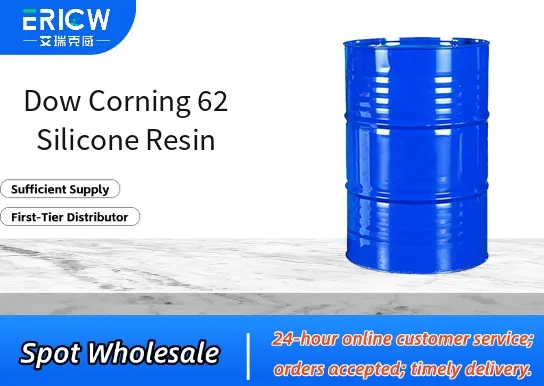
Q1: What is the primary function of Dow Corning® 62 Silicone Resin in coating formulations?
A: Dow Corning® 62 is a methyl-phenyl silicone resin designed primarily to enhance surface hardness, mar resistance, and thermal stability in high-performance organic coatings—especially in baked enamel systems for metal substrates.
Q2: Is Dow Corning® 62 compatible with common organic resins such as acrylics, alkyds, and epoxies?
A: Yes, it exhibits good compatibility with many thermosetting organic resins when properly blended and cured. Compatibility should be verified experimentally in the final formulation due to variations in solvent systems, catalysts, and cure schedules.
Q3: How is Dow Corning® 62 typically incorporated into a coating system?
A: It is generally added during the let-down stage as a solution in aromatic or ketonic solvents. Dosage depends on formulation requirements but is typically used at low concentrations to modify film properties without compromising flexibility or adhesion.
Q4: Does Dow Corning® 62 require a catalyst or specific cure conditions to achieve optimal performance?
A: It is intended for use in thermally cured systems, where crosslinking occurs upon baking—typically above 150 °C. While it can co-cure with conventional amino resins or metal soaps, no dedicated catalyst is required; however, cure profile optimization is recommended for each application.
Contact With Us:
E-mail: wangxingqiang@ericwchem.com
Have a Questions? Call Us:
Add:
Building A1, Jiete Industrial Park, Huangpu District, Guangzhou City, Guangdong Province, China