English
 Español
 tiếng việt
 русский
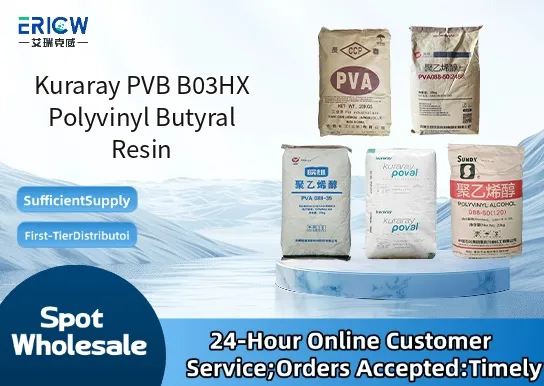
High clarity and excellent optical transparency for premium laminated safety glass performance.
Superior adhesion to both glass and polycarbonate substrates, ensuring reliable interlayer bonding.
Optimized rheology for efficient solvent-based coating and casting processes in industrial lamination lines.
Consistent batch-to-batch quality with stringent control over residual vinyl alcohol and butyral content.
Enhanced toughness and impact resistance under low-temperature conditions, meeting automotive safety standards.
Automotive laminated windshields and side windows requiring high optical quality and structural integrity.
Architectural safety glazing for façades, skylights, and overhead installations.
Security laminates for blast-resistant and forced-entry resistant glass systems.
Photovoltaic module encapsulation layers providing moisture barrier and mechanical protection.
Specialty optical films for display protection and anti-reflective laminates.
| Chemical Type | Polyvinyl butyral (PVB) resin |
| Product Form | White granular solid |
| Appearance | Free-flowing, uniform granules |
| Primary Applications | Laminated safety glass interlayer |
| Key Features | High clarity, strong adhesion, low yellowing index |
| Benefits | Improved processing stability, enhanced edge durability, UV stability |
| Solubility | Soluble in alcohols, ketones, and ester-based solvents |
| Storage Conditions | Store in cool, dry place; protect from moisture and direct sunlight |
Q1: What is the primary functional role of Kuraray PVB B03HX in adhesive and coating formulations?
A: Kuraray PVB B03HX serves primarily as a high-performance binder and film-forming resin, offering excellent adhesion to diverse substrates—including glass, metals, and polar plastics—along with good flexibility, clarity, and moisture resistance. Its balanced butyral/acetal/hydroxyl composition supports strong interfacial bonding and cohesive strength in solvent-based systems.
Q2: Is PVB B03HX compatible with common organic solvents used in industrial coatings?
A: Yes, PVB B03HX exhibits good solubility in typical coating solvents such as ethanol, methanol, isopropanol, ethyl acetate, and ketones (e.g., MEK, MIBK), enabling straightforward incorporation into clear lacquers, laminating adhesives, and protective overcoats without requiring aggressive co-solvents or extended dispersion times.
Q3: How does PVB B03HX compare to standard PVB resins in terms of thermal stability and processing window?
A: PVB B03HX is formulated for enhanced thermal stability relative to conventional low-molecular-weight PVB grades, allowing stable processing at elevated temperatures during drying or lamination without premature degradation or discoloration. It maintains viscosity integrity over a broader temperature range, supporting consistent film formation in high-speed coating operations.
Q4: Can PVB B03HX be blended with other resins to modify performance characteristics?
A: Yes, PVB B03HX is widely used in hybrid resin systems—for example, with acrylics, polyurethanes, or cellulose derivatives—to fine-tune flexibility, hardness, chemical resistance, or substrate wetting. Compatibility should be verified empirically in the final formulation, but it generally shows favorable miscibility with many polar synthetic resins in common solvent media.
Contact With Us:
E-mail: wangxingqiang@ericwchem.com
Have a Questions? Call Us:
Add:
Building A1, Jiete Industrial Park, Huangpu District, Guangzhou City, Guangdong Province, China