English
 Español
 tiếng việt
 русский
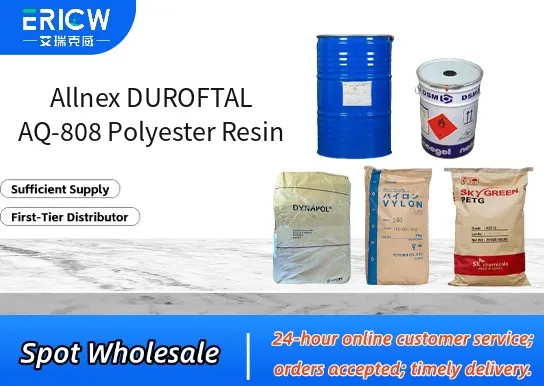
Waterborne polyester dispersion offering excellent hydrolytic stability and low VOC content.
Designed for high-gloss, durable topcoats with superior weather resistance and UV stability.
Provides outstanding compatibility with acrylic dispersions and crosslinkers such as melamine and polyisocyanates.
Enables low-temperature film formation and good substrate wetting on metals and plastics.
Delivers balanced hardness, flexibility, and chemical resistance in cured films.
Architectural and industrial maintenance coatings.
Coil coating topcoats for pre-painted metal substrates.
Automotive refinish clearcoats and basecoat/clearcoat systems.
General-purpose protective coatings for metal furniture and outdoor equipment.
High-performance waterborne can and closure coatings.
| Chemical Type | Waterborne saturated polyester dispersion |
| Product Form | Opaque white to off-white liquid |
| Appearance | Homogeneous aqueous dispersion |
| pH (at 25°C) | 7.5 – 8.5 |
| Solids Content (wt%) | 38 – 42 |
| Viscosity (mPa·s, Brookfield RVT, #2 spindle, 20 rpm) | 100 – 500 |
| Density (g/cm³, 20°C) | 1.02 – 1.06 |
| Primary Applications | Waterborne high-performance topcoats and clearcoats |
Q1: What is the primary application of DUROFTAL AQ-808 in waterborne coatings?
A: DUROFTAL AQ-808 is a water-dispersible saturated polyester resin designed primarily as a crosslinker for ambient-cure or low-bake waterborne acrylic and polyurethane systems, commonly used in industrial maintenance, general metal finishing, and light-duty coil coating applications where good hardness, chemical resistance, and gloss retention are required.
Q2: Is DUROFTAL AQ-808 compatible with common waterborne resins such as acrylics and polyurethanes?
A: Yes, DUROFTAL AQ-808 exhibits broad compatibility with waterborne acrylic dispersions, polyurethane dispersions, and hybrid systems. Its tailored hydrophilicity and functional group balance support stable formulation and efficient crosslinking without significant viscosity build-up or phase separation under standard dispersion conditions.
Q3: What type of curing mechanism does DUROFTAL AQ-808 rely on?
A: DUROFTAL AQ-808 contains reactive hydroxyl groups and is typically used with melamine-formaldehyde or blocked isocyanate crosslinkers. It does not self-crosslink but participates in thermally activated condensation or addition reactions during baking—enabling film formation with enhanced durability and resistance properties at moderate cure temperatures.
Q4: How should DUROFTAL AQ-808 be incorporated into a waterborne formulation?
A: It is generally added during the let-down stage under mild agitation, after the main binder dispersion has been stabilized. pH adjustment may be necessary to maintain colloidal stability, and compatibility testing with other additives (e.g., surfactants, defoamers) is recommended prior to full-scale production.
Q5: Does DUROFTAL AQ-808 contain formaldehyde or release formaldehyde during use?
A: DUROFTAL AQ-808 itself is a formaldehyde-free polyester resin. However, its performance in final formulations depends on the choice of crosslinker; when paired with formaldehyde-based melamines, formaldehyde release may occur during thermal curing. For formaldehyde-free systems, it can be combined with alternative crosslinkers such as carbodiimides or aziridines.
Contact With Us:
E-mail: wangxingqiang@ericwchem.com
Have a Questions? Call Us:
Add:
Building A1, Jiete Industrial Park, Huangpu District, Guangzhou City, Guangdong Province, China