English
 Español
 tiếng việt
 русский
High solids content for reduced VOC emissions and improved coating efficiency.
Excellent compatibility with acrylic and polyester co-resins in hybrid systems.
Outstanding flexibility and impact resistance after curing, even at low film thicknesses.
Good hydrolytic stability suitable for demanding outdoor and humid-condition applications.
Designed for ambient- or low-bake cure profiles, supporting energy-efficient manufacturing.
Automotive refinish clearcoats and basecoat/clearcoat systems.
Industrial maintenance coatings for metal substrates including machinery and equipment.
Architectural façade coatings requiring UV resistance and long-term gloss retention.
Plastic coatings for automotive interior trim and exterior decorative components.
General-purpose high-performance topcoats for wood and composite substrates.
| Chemical Type | Aliphatic polyurethane dispersion (PUD) |
| Product Form | Aqueous dispersion |
| Appearance | Translucent to slightly hazy liquid |
| Solids Content (wt%) | 40 ± 1.5% |
| pH | 7.5 – 8.5 |
| Viscosity (mPa·s, Brookfield LVT, #2 spindle, 20 rpm, 25°C) | 150 – 400 |
| Particle Size (D50, nm) | 80 – 120 |
| Minimum Film Formation Temperature (MFFT, °C) | ≥ 15 |
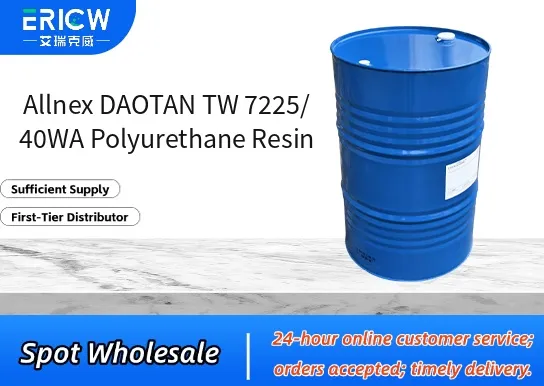
Q1: What is the primary function of DAOTAN TW 7225/40WA in polyurethane systems?
A: DAOTAN TW 7225/40WA is a water-dispersible polyurethane resin designed primarily as a crosslinker or reactive modifier to enhance film hardness, chemical resistance, and mechanical durability in aqueous PU coatings and adhesives.
Q2: Is DAOTAN TW 7225/40WA compatible with standard anionic or non-ionic waterborne polyurethane dispersions?
A: Yes — it is formulated for broad compatibility with common anionic and non-ionic waterborne PU dispersions, enabling stable blends without significant viscosity increase or phase separation under typical formulation conditions.
Q3: How should DAOTAN TW 7225/40WA be incorporated into a coating formulation?
A: It is typically added during the final stage of formulation, under gentle agitation, at ambient temperature. Pre-dilution with deionized water may be used to facilitate uniform dispersion, especially in high-solids systems.
Q4: Does this resin require thermal curing, or can it achieve full performance at ambient conditions?
A: While ambient cure provides initial film formation, optimal crosslink density and final performance properties — including solvent and abrasion resistance — are generally achieved with mild thermal post-curing (e.g., 60–80 °C for 15–30 minutes), depending on film thickness and substrate.
Contact With Us:
E-mail: wangxingqiang@ericwchem.com
Have a Questions? Call Us:
Add:
Building A1, Jiete Industrial Park, Huangpu District, Guangzhou City, Guangdong Province, China