English
 Español
 tiếng việt
 русский
Excellent film clarity and gloss retention after curing
Low VOC content, compliant with stringent environmental regulations (e.g., EU REACH, US EPA)
Good mechanical strength and abrasion resistance in dried films
Stable dispersion in water with broad compatibility with acrylic co-resins and additives
Fast ambient-temperature drying with balanced open time for industrial coating processes
Waterborne wood coatings for furniture and flooring
Leather finishing topcoats requiring flexibility and breathability
Plastic substrates coating (e.g., ABS, PC) for electronics and automotive interiors
Industrial maintenance coatings for metal and concrete surfaces
High-performance textile finishes for technical fabrics
| Chemical Type | Aliphatic waterborne polyurethane dispersion (PUD) |
| Product Form | Opaque white to slightly bluish aqueous dispersion |
| Appearance | Homogeneous liquid, free of gel or sediment |
| Solids Content (wt%) | 30.0 ± 1.5% |
| pH | 7.8 – 8.5 |
| Viscosity (mPa·s, 25°C, Brookfield RVT #2, 20 rpm) | 800 – 1,500 |
| Particle Size (D50, nm) | 80 – 120 |
| Minimum Film Formation Temperature (MFFT) | ≥ 10°C |
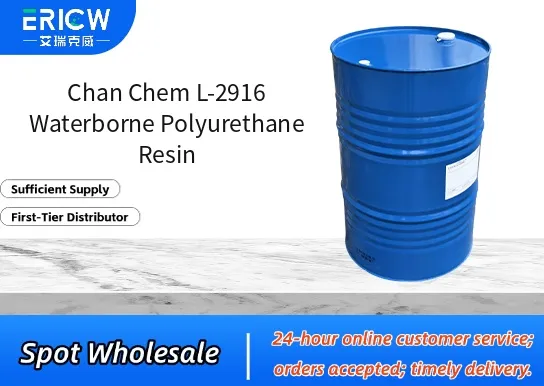
Q1: What are the primary application areas for Chan Chem L-2916?
A: Chan Chem L-2916 is widely used in waterborne industrial coatings, including flexible packaging laminating adhesives, textile and leather finishing systems, and protective topcoats for wood and plastic substrates where low VOC, good film flexibility, and balanced chemical resistance are required.
Q2: How does L-2916 compare to solvent-based polyurethane resins in terms of performance?
A: L-2916 delivers comparable film toughness, abrasion resistance, and substrate adhesion to many conventional solvent-based systems, while offering significantly lower VOC content and improved workplace safety. Final film properties may require minor formulation adjustments—especially regarding coalescence, drying kinetics, and crosslinker selection—to match specific end-use demands.
Q3: Is L-2916 compatible with common waterborne acrylic or epoxy dispersions?
A: Yes, L-2916 exhibits good compatibility with many commercial waterborne acrylic emulsions and epoxy dispersions when blended under controlled pH and shear conditions. Compatibility testing—including stability assessment over time and after freeze-thaw cycling—is recommended before full-scale integration into hybrid formulations.
Q4: What type of crosslinkers can be used with L-2916 to enhance performance?
A: L-2916 is designed to react effectively with standard water-dispersible polyisocyanate crosslinkers, as well as aziridine- and carbodiimide-based systems. Selection depends on cure temperature, pot life requirements, and final film property targets such as chemical resistance or heat stability.
Contact With Us:
E-mail: wangxingqiang@ericwchem.com
Have a Questions? Call Us:
Add:
Building A1, Jiete Industrial Park, Huangpu District, Guangzhou City, Guangdong Province, China