English
 Español
 tiếng việt
 русский
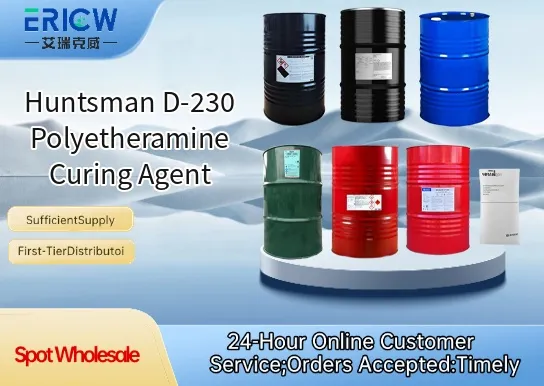
Low-viscosity liquid polyetheramine with excellent reactivity toward epoxy resins.
Enables fast room-temperature cure with superior flexibility and impact resistance.
Provides low exotherm during curing, reducing thermal stress in thick-section castings.
Offers outstanding adhesion to metals, composites, and concrete substrates.
Delivers hydrolytic stability and low moisture sensitivity compared to aliphatic amines.
Epoxy-based structural adhesives for aerospace and automotive assembly.
High-performance flooring systems requiring rapid return-to-service.
Electrical potting and encapsulation compounds for power electronics.
Composite matrix resins for wind turbine blades and marine laminates.
Repair mortars and polymer-modified grouts for infrastructure rehabilitation.
| Chemical Type | Difunctional polyetheramine (primary/secondary amine) |
| Product Form | Liquid |
| Appearance | Clear, pale yellow liquid |
| Amine Value | 450–480 mg KOH/g |
| Viscosity (25°C) | 150–250 cP |
| Primary Applications | Epoxy resin curing agent for structural adhesives, coatings, and composites |
| Key Features | Room-temperature cure, flexible network, low exotherm, moisture tolerance |
| Benefits | Improved toughness, reduced cracking, extended working life, simplified processing |
Q1: What is the primary function of D-230 in epoxy formulations?
A: D-230 is a low-viscosity, aliphatic polyetheramine curing agent designed to react with epoxy resins, enabling crosslinking at ambient or elevated temperatures. It imparts flexibility, toughness, and good chemical resistance to the cured network while maintaining low moisture sensitivity compared to many amine alternatives.
Q2: How does D-230 compare to other polyetheramine curing agents like D-400 or D-2000?
A: D-230 has a lower molecular weight and higher amine hydrogen equivalent weight than D-400 or D-2000, resulting in faster reactivity, higher crosslink density, and improved hardness in the cured film. It offers a balance between reactivity and flexibility—more reactive than D-400 but less flexible than D-2000—making it well-suited for coatings and adhesives requiring rapid development of handling strength.
Q3: Is D-230 suitable for moisture-critical applications such as concrete primers or marine coatings?
A: Yes—D-230 exhibits relatively low sensitivity to ambient moisture during mixing and application compared to traditional aliphatic amines, which helps reduce surface blushing and improves pot life consistency in humid conditions. However, proper substrate preparation and environmental control remain essential for optimal performance in demanding environments.
Q4: What are typical handling and storage recommendations for D-230?
A: D-230 should be stored in tightly sealed containers under dry, cool conditions (preferably below 30 °C) and protected from moisture and atmospheric carbon dioxide. Prolonged exposure to air may lead to surface crystallization or slight viscosity increase due to carbamate formation, but full functionality is typically retained after gentle warming and mixing.
Contact With Us:
E-mail: wangxingqiang@ericwchem.com
Have a Questions? Call Us:
Add:
Building A1, Jiete Industrial Park, Huangpu District, Guangzhou City, Guangdong Province, China