English
 Español
 tiếng việt
 русский
Excellent abrasion resistance for demanding mechanical environments.
Outstanding flexibility and low-temperature performance down to –40 °C.
Good oil, grease, and hydrocarbon resistance.
High melt flow index enabling efficient processing via extrusion and injection molding.
Consistent batch-to-batch quality with tight molecular weight distribution.
Automotive interior trim components including instrument panel skins and door panels.
Industrial hoses and pneumatic tubing requiring flexibility and pressure resilience.
Protective overmolding for electronic enclosures and handheld devices.
Footwear midsoles and outsoles where dynamic elasticity and durability are critical.
Medical device tubing and wearable sensor housings compliant with ISO 10993 biocompatibility guidelines (when processed under controlled conditions).
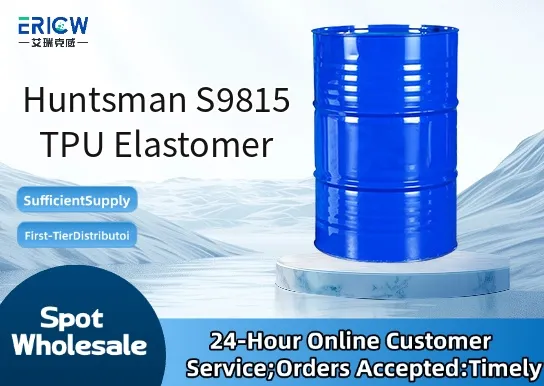
| Chemical Type | Thermoplastic Polyurethane (TPU), polyester-based |
| Product Form | Pellets |
| Appearance | Off-white to light tan, free-flowing granules |
| Hardness (Shore A) | 95 ± 2 |
| Melt Flow Index (230 °C / 2.16 kg) | 12–16 g/10 min |
| Density | 1.20–1.22 g/cm³ |
| Processing Temperature Range | 190–230 °C |
| Key Features | High elasticity, excellent tear strength, low compression set |
Q1: What is the primary function of S9815 in thermoplastic polyurethane (TPU) formulations?
A: S9815 is a high-performance chain extender designed to enhance mechanical strength, thermal stability, and melt processability in aromatic TPU systems. It enables improved tensile properties and resilience without compromising extrusion or injection molding performance.
Q2: Is S9815 compatible with common TPU base resins and processing methods?
A: Yes — S9815 is fully compatible with standard aromatic TPU prepolymers and widely used in melt-phase polymerization processes, including twin-screw extrusion and continuous belt casting. It exhibits excellent dispersion and reactivity under typical TPU synthesis conditions.
Q3: How does S9815 compare to conventional diamine chain extenders in terms of processing safety?
A: Unlike highly reactive aliphatic or aromatic diamines, S9815 offers moderated reactivity and reduced sensitivity to moisture, supporting more robust handling and broader processing windows. This contributes to improved batch consistency and lower risk of gelation during production.
Q4: Can S9815 be used in applications requiring regulatory compliance for indirect food contact or skin contact?
A: S9815 is formulated to support compliance-ready TPU systems. While final regulatory status depends on full formulation and end-use conditions, it is commonly selected for applications where low extractables and inherent hydrolytic stability are valued — such as medical tubing, wearable device components, and food-grade conveying surfaces.
Contact With Us:
E-mail: wangxingqiang@ericwchem.com
Have a Questions? Call Us:
Add:
Building A1, Jiete Industrial Park, Huangpu District, Guangzhou City, Guangdong Province, China