English
 Español
 tiếng việt
 русский
Excellent melt processability for high-speed extrusion and injection molding.
Superior soft-touch feel with balanced hardness (Shore A 90) and elasticity.
Good resistance to UV exposure and thermal aging, enhancing long-term durability.
Low compression set for reliable sealing and gasket performance in dynamic applications.
Halogen-free formulation compliant with RoHS and REACH environmental regulations.
Automotive interior trim components including door panels, armrests, and console covers.
Consumer electronics casings and protective overmolding for smartphones and wearables.
Medical device grips and ergonomic handles requiring skin-safe, non-slip surfaces.
Household appliance seals, knobs, and soft-touch control interfaces.
Industrial tool overmolded grips and vibration-damping components.
| Chemical Type | Thermoplastic Elastomer (TPE) – Styrenic Block Copolymer (SBC) based |
| Product Form | Pellets |
| Appearance | Opaque off-white granules |
| Shore Hardness (ASTM D2240) | 90 A |
| Melt Flow Rate (200°C/5 kg, ASTM D1238) | 12 g/10 min |
| Density (ASTM D792) | 0.99 g/cm³ |
| Continuous Use Temperature Range | −40°C to +70°C |
| Primary Applications | Soft-touch overmolding, sealing, ergonomic grips |
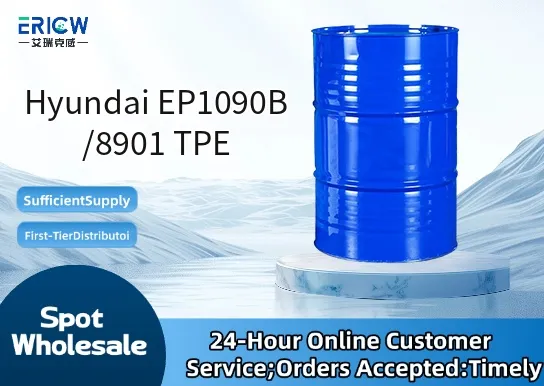
Q1: What is the primary application domain for Hyundai EP1090B/8901 TPE?
A: Hyundai EP1090B/8901 TPE is engineered primarily for soft-touch overmolding and functional elastomeric components in automotive interior systems, including control knobs, gear shift boots, and trim bezels requiring consistent tactile response and long-term dimensional stability.
Q2: How does EP1090B/8901 perform in terms of adhesion to common engineering thermoplastics?
A: It exhibits strong inherent adhesion to polypropylene (PP), polyethylene (PE), and ABS substrates without requiring primers or surface treatments under standard injection overmolding conditions, though optimal bonding depends on proper mold temperature, melt temperature, and interfacial cleanliness.
Q3: Is this grade suitable for applications requiring low-temperature flexibility?
A: Yes — EP1090B/8901 maintains excellent elasticity and impact resistance down to −30 °C, making it well-suited for automotive interior parts exposed to cold-climate operating environments.
Q4: What are the recommended drying and processing conditions?
A: Prior to processing, drying at 70–80 °C for 2–4 hours is recommended to achieve moisture content below 0.05%. Typical melt processing temperatures range from 180 °C to 220 °C, with mold temperatures between 25 °C and 45 °C depending on part geometry and cycle requirements.
Contact With Us:
E-mail: wangxingqiang@ericwchem.com
Have a Questions? Call Us:
Add:
Building A1, Jiete Industrial Park, Huangpu District, Guangzhou City, Guangdong Province, China