English
 Español
 tiếng việt
 русский
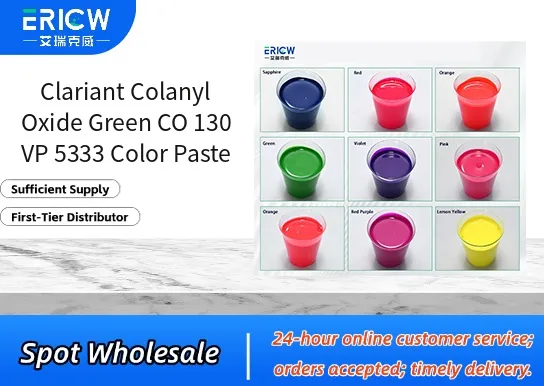
High chroma, bluish-shade oxide green pigment dispersion with excellent lightfastness and weather resistance.
Optimized rheology for easy incorporation into water-based and solvent-based systems without regrinding.
Low volatile organic compound (VOC) content, supporting compliance with stringent environmental and regulatory standards.
Consistent batch-to-batch color strength and hue stability, ensuring reliable production repeatability.
Enhanced dispersibility in acrylic, polyester, and alkyd resin systems for superior gloss retention and film integrity.
Architectural and industrial coatings, including exterior façade paints and protective finishes.
Plastic coloration for rigid PVC, ABS, and polyolefins used in construction profiles and automotive trim.
Printing inks for packaging applications requiring high opacity and UV resistance.
Wood stains and clear-coat tints where color purity and long-term fade resistance are critical.
Specialty powder coatings for metal furniture and outdoor equipment.
| Chemical Type | Metal oxide pigment dispersion (chromium oxide green-based) |
| Product Form | Paste (liquid dispersion) |
| Appearance | Viscous, homogeneous green paste |
| Primary Applications | Coatings, plastics, inks, and wood finishes |
| Key Features | High opacity, excellent heat stability up to 220 °C, low migration |
| Benefits | Reduced formulation complexity, improved color consistency, regulatory compliance (REACH, RoHS) |
| VOC Content | <50 g/L (as per ISO 11890-2) |
| Recommended Carrier | Water and/or propylene glycol monomethyl ether acetate (PMA) |
Q1: What types of polymer systems is this color paste compatible with?
A: Clariant Colanyl Oxide Green CO 130 VP 5333 is specifically formulated for use in polyolefin-based systems, including PP and HDPE, and demonstrates good compatibility in certain engineering thermoplastics under standard processing conditions. Compatibility should always be verified during formulation development.
Q2: Is this product suitable for applications requiring thermal stability during extrusion or injection molding?
A: Yes — the pigment dispersion is designed to withstand typical polyolefin processing temperatures up to approximately 260 °C, offering good resistance to thermal degradation and minimal color shift when processed within recommended time-temperature windows.
Q3: How is dosage typically determined in production formulations?
A: Dosage depends on formulation requirements and desired color strength, but it is generally used at low concentrations — typically ranging from 0.1% to 2% by weight relative to the base polymer — with optimization guided by lab-scale trials and spectral evaluation.
Q4: Does this color paste contain heavy metals or restricted substances?
A: This product is formulated without intentionally added heavy metals such as lead, cadmium, mercury, or hexavalent chromium, and complies with Clariant’s internal restricted substances list. Regulatory compliance for specific end-use markets must be confirmed separately based on applicable legislation.
Contact With Us:
E-mail: wangxingqiang@ericwchem.com
Have a Questions? Call Us:
Add:
Building A1, Jiete Industrial Park, Huangpu District, Guangzhou City, Guangdong Province, China