English
 Español
 tiếng việt
 русский
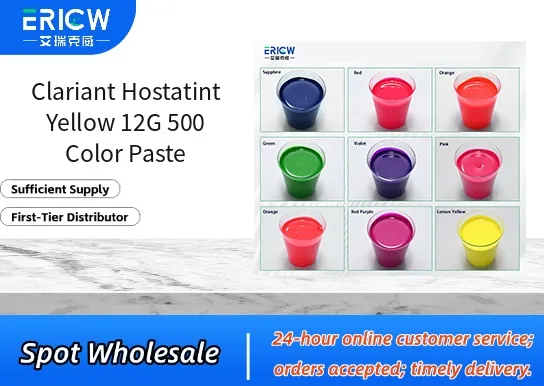
High chroma, clean yellow shade with excellent lightfastness in demanding applications.
Optimized for compatibility with polyolefins, ABS, PS, and engineering thermoplastics.
Low migration and bleed resistance ensuring color stability during processing and end-use.
Ready-to-use liquid paste formulation enabling precise dosing and homogeneous dispersion.
Free of heavy metals and compliant with major global regulatory frameworks including EU REACH.
Coloration of polypropylene (PP) fibers for automotive interiors and technical textiles.
Masterbatch production for injection-molded consumer goods and packaging components.
Pigmenting ABS housings for electronics and household appliances.
Coloration of polystyrene (PS) trays and rigid packaging requiring FDA-compliant options.
| Chemical Type | Azo pigment dispersion |
| Product Form | Liquid color paste (solvent-free) |
| Appearance | Homogeneous yellow paste, free of visible particles |
| Primary Applications | Polyolefins, ABS, PS, engineering plastics |
| Key Features | High thermal stability up to 260°C, low dusting, excellent dispersibility |
| Benefits | Consistent batch-to-batch performance, reduced machine fouling, simplified handling |
| Regulatory Compliance | EU REACH registered; meets Clariant’s Restricted Substances List (RSL) |
Q1: What is the primary application field for Hostatint Yellow 12G 500?
A: Hostatint Yellow 12G 500 is a high-performance organic pigment dispersion specifically developed for coloring polyolefin compounds—especially injection-molded and extruded PP and PE parts—where excellent heat stability, lightfastness, and dispersion quality are required.
Q2: Is this color paste suitable for food-contact applications?
A: Hostatint Yellow 12G 500 is formulated without heavy metals and complies with general requirements for indirect food contact in polyolefins, subject to final regulatory review and end-use conditions. Users must verify compliance with applicable regional regulations and conduct appropriate migration testing for their specific application.
Q3: How should the paste be incorporated into polyolefin compounds?
A: It is typically added directly during compounding—via side feeder or gravimetric dosing—and disperses efficiently under standard melt processing conditions. Pre-drying is not required, but good mixing intensity and residence time are recommended to ensure uniform distribution and optimal color development.
Q4: What are the key handling and storage recommendations?
A: Store in original sealed containers at temperatures between 5 °C and 30 °C, away from direct sunlight and freezing conditions. Avoid prolonged exposure to air to prevent surface skinning. Stir gently before use if sedimentation occurs after extended storage.
Contact With Us:
E-mail: wangxingqiang@ericwchem.com
Have a Questions? Call Us:
Add:
Building A1, Jiete Industrial Park, Huangpu District, Guangzhou City, Guangdong Province, China