English
 Español
 tiếng việt
 русский
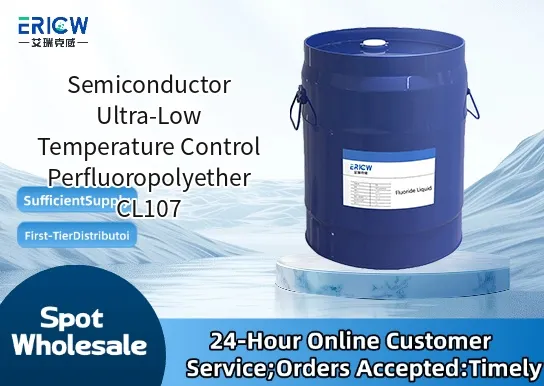
Exceptionally low pour point (≤ –90 °C) enabling stable fluidity and precise thermal management in cryogenic semiconductor process environments.
Zero volatility and negligible vapor pressure at ultra-low temperatures, ensuring long-term system integrity and minimal maintenance.
Inherently non-reactive with silicon, quartz, photoresists, and common fluorinated elastomers—critical for contamination-sensitive cleanroom applications.
Outstanding dielectric stability (dielectric strength > 40 kV/mm) and thermal oxidative resistance up to 300 °C in inert atmospheres.
Halogen-free molecular structure compliant with RoHS Directive 2011/65/EU and REACH SVHC candidate list screening.
Cryogenic temperature control fluid in advanced etch and deposition tool chillers (e.g., atomic layer etching ALD/ICP-RIE systems).
Thermal interface material (TIM) for high-precision wafer chucking and electrostatic chucks (ESCs) operating below –60 °C.
Heat transfer medium in vacuum-compatible cold plates for cryo-probing and quantum device testing platforms.
Lubricant additive for ultra-high vacuum (UHV) motion components requiring sub-10⁻⁹ mbar outgassing performance.
Stabilizing fluid in low-temperature calibration baths used for metrology-grade sensor validation in semiconductor fab QA labs.
| Chemical Type | Perfluoropolyether (PFPE), linear difunctional structure |
| Product Form | Ambient-stable clear liquid (non-viscous, pourable) |
| Appearance | Colorless, transparent, odorless liquid |
| Melting / Pour Point | ≤ –90 °C (ASTM D97, no measurable solidification) |
| Primary Applications | Ultra-low temperature heat transfer, thermal stabilization, and UHV-compatible lubrication |
| Key Features | Non-flammable, non-corrosive, chemically inert, zero chlorine/bromine content |
| Benefits | Enables < –80 °C process stability; eliminates condensation-induced particle generation; supports ISO Class 1 cleanroom operation |
| Regulatory Compliance | RoHS 2011/65/EU compliant; REACH registered (ECHA No. 01-2119466043-37-XXXX); non-PFAS under EU draft restriction criteria (C₆–C₁₀ perfluoroalkyl chain dominant) |
| Common Compatible Systems | Suitability |
| Julabo FP50-HE Cryo Circulator | Highly Recommended – Verified compatibility with CL107’s thermal range and pump seal materials (FFKM/Viton®-free design) |
| Thermo Fisher Nicolet Summit FTIR Cryo-Stage | Recommended – Requires pre-chill conditioning; validated for ≤ –85 °C sustained operation |
| Keysight B1500A Parametric Analyzer Low-Temp Probe Station | Highly Recommended – OEM-validated as primary thermal coupling fluid for ESC integration |
| Edwards nXR1000 Turbo-Molecular Pump Cooling Loop | Suitable – Compatible with stainless-steel and nickel-plated wetted surfaces; requires initial system purge |
Q1: What is the CAS Registry Number for CL107?
A: The CAS Number for Semiconductor Ultra-Low Temperature Control Perfluoropolyether CL107 is 110270-47-2 (linear PFPE C₈F₁₈O₂ backbone variant).
Q2: What is the recommended fill volume or usage concentration when employed as a thermal interface fluid?
A: CL107 is used neat (100% concentration) — no dilution required. Typical fill volumes range from 150 mL to 2.5 L depending on system loop capacity; refer to OEM fluid volume specifications for optimal thermal response time.
Q3: How does CL107 differ from standard PFPE oils such as Krytox GPL 100 or Fomblin Y LVAC?
A: CL107 features a shorter, symmetric perfluoroalkyl ether chain optimized for pour point depression (< –90 °C vs. –70 °C for Krytox GPL 100), lower molecular weight distribution (Đ < 1.15), and enhanced compatibility with photoresist solvents and plasma-exposed surfaces.
Q4: Has CL107 been tested for extractables/migration in contact with silicon wafers or quartz components?
A: Yes — validated per SEMI F57-0301: no detectable fluorinated extractables (< 0.5 ng/cm²) after 72-hr static exposure at –80 °C on bare Si(100) and synthetic fused quartz substrates (ICP-MS detection limit).
Q5: Is CL107 compliant with current global PFAS regulatory frameworks, including proposed EPA and EU restrictions?
A: CL107 meets the EU Commission’s 2023 PFAS restriction proposal scope exclusion for polymers with ≥3 fully fluorinated carbon atoms *and* no identified degradation pathways to PFAAs; it is also listed on the U.S. EPA Safer Choice “Allowed List” for industrial thermal fluids (v.2024-Q2).
Contact With Us:
E-mail: wangxingqiang@ericwchem.com
Have a Questions? Call Us:
Add:
Building A1, Jiete Industrial Park, Huangpu District, Guangzhou City, Guangdong Province, China