English
 Español
 tiếng việt
 русский
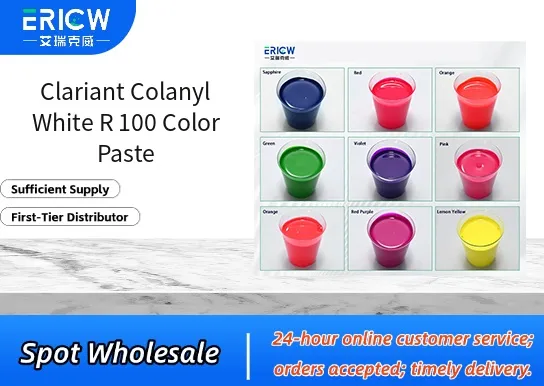
High-opacity titanium dioxide-based white colorant for excellent hiding power in demanding applications.
Optimized rheology for easy dispersion and stable incorporation into water-based and solvent-based systems.
Excellent lightfastness and thermal stability, ensuring long-term color integrity during processing and service life.
Low volatile organic compound (VOC) content, supporting compliance with stringent environmental and regulatory standards.
Consistent batch-to-batch color strength and hue, enabling reliable formulation repeatability and quality control.
Architectural and industrial waterborne coatings (e.g., interior/exterior paints, primers).
Plastic coloration for polyolefins, PVC, and ABS in extrusion and injection molding processes.
Printing inks for flexible packaging and publication gravure/offset applications.
Wood coatings including stains, varnishes, and clear finishes requiring high whiteness and clarity.
Adhesives and sealants where neutral white tone and minimal substrate interaction are critical.
| Chemical Type | Titanium dioxide (TiO₂) pigment dispersion |
| Product Form | Paste (liquid concentrate) |
| Appearance | Opaque white, homogeneous paste without visible grit or separation |
| Primary Applications | Water-based and solvent-based coatings, plastics, inks, adhesives |
| Key Features | High opacity, low VOC, excellent dispersibility, thermal stability |
| Benefits | Reduced formulation complexity, improved color consistency, enhanced regulatory compliance |
| Storage Stability | 12 months in original sealed container at 5–30 °C |
| Compatible Media | Acrylic, styrene-acrylic, PUD, alkyd, polyester, and cellulose ester systems |
Q1: What types of polymers is Colanyl White R 100 compatible with?
A: Colanyl White R 100 is formulated for use in a broad range of thermoplastics, including polyolefins (PP, PE), styrenics (PS, ABS), and engineering plastics such as PA and PC. Compatibility should be verified under actual processing conditions due to formulation-specific interactions.
Q2: How is Colanyl White R 100 typically dosed in polymer masterbatch or direct compounding?
A: It is typically used at low concentrations, generally ranging from 0.1% to 2% by weight relative to the base polymer, depending on the desired opacity, brightness, and final application requirements. Optimal dosage should be determined through lab-scale trials and rheological evaluation.
Q3: Does Colanyl White R 100 contain heavy metals or restricted substances?
A: Colanyl White R 100 is manufactured without intentionally added heavy metals (e.g., lead, cadmium, mercury, hexavalent chromium) and complies with Clariant’s internal Restricted Substances List (RSL). It is not certified for food-contact or medical applications unless explicitly validated per regional regulatory requirements.
Q4: Can Colanyl White R 100 be used in high-temperature processing applications?
A: Yes — it is designed for thermal stability during standard extrusion and injection molding processes. Performance at elevated temperatures (e.g., above 260 °C) depends on residence time, shear history, and polymer matrix; extended thermal exposure may affect dispersion quality or hue consistency.
Contact With Us:
E-mail: wangxingqiang@ericwchem.com
Have a Questions? Call Us:
Add:
Building A1, Jiete Industrial Park, Huangpu District, Guangzhou City, Guangdong Province, China