English
 Español
 tiếng việt
 русский
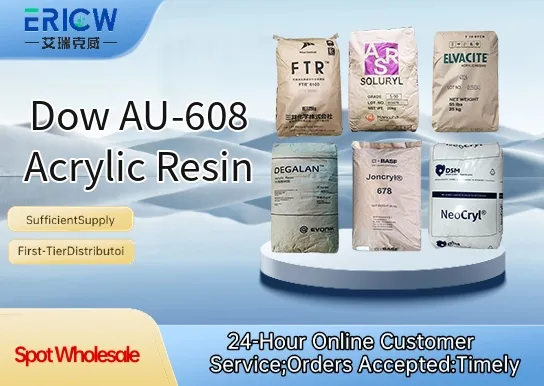
High solids content for reduced VOC emissions and improved coating efficiency.
Excellent UV resistance and long-term color stability in exterior applications.
Good compatibility with common crosslinkers including melamine and polyisocyanates.
Superior gloss retention and film clarity after curing.
Consistent batch-to-batch performance ensured by Dow’s stringent quality control.
Automotive OEM clearcoats and basecoat/clearcoat systems.
Industrial maintenance coatings for metal substrates.
Architectural high-performance facade coatings.
Powder coating formulations requiring acrylic backbone functionality.
UV-curable hybrid systems where acrylic resin contributes to flexibility and adhesion.
| Chemical Type | Thermosetting acrylic copolymer |
| Product Form | Liquid resin solution |
| Appearance | Clear, pale yellow to amber liquid |
| Solvent System | Standard aromatic/aliphatic blend (non-halogenated) |
| Non-Volatile Content (wt%) | 55–60% (as received) |
| Acid Value (mg KOH/g) | 15–25 |
| Weight-Average Molecular Weight (Mw) | ~4,000–6,000 Da |
| Viscosity (25°C, mPa·s) | 1,200–2,500 (Brookfield, spindle #3, 20 rpm) |
Q1: What is the primary function of Dow AU-608 in coating formulations?
A: Dow AU-608 is a waterborne acrylic resin designed primarily as a rheology modifier and film-forming aid in architectural and industrial water-based coatings. It helps improve sag resistance, enhance leveling, and support stable pigment dispersion without compromising gloss or scrub resistance.
Q2: Is Dow AU-608 compatible with common co-binders and additives used in latex paints?
A: Yes, Dow AU-608 exhibits broad compatibility with typical acrylic and vinyl acetate–based latexes, as well as common thickeners, defoamers, and biocides. Compatibility testing under actual formulation conditions is recommended to confirm performance stability and avoid unintended interactions.
Q3: How should Dow AU-608 be incorporated into a water-based coating system?
A: It is typically added during the let-down stage, after the pigment grind paste has been dispersed and diluted. To ensure optimal performance, it should be introduced gradually with gentle agitation—avoid high-shear mixing at this stage to prevent viscosity loss or destabilization.
Q4: Does Dow AU-608 contribute to final film properties such as hardness or flexibility?
A: While not a primary film former, Dow AU-608 can influence film integrity by promoting uniform coalescence and interparticle fusion. It generally supports balanced film development—contributing to improved early water resistance and moderate flexibility without significantly increasing brittleness.
Contact With Us:
E-mail: wangxingqiang@ericwchem.com
Have a Questions? Call Us:
Add:
Building A1, Jiete Industrial Park, Huangpu District, Guangzhou City, Guangdong Province, China