English
 Español
 tiếng việt
 русский
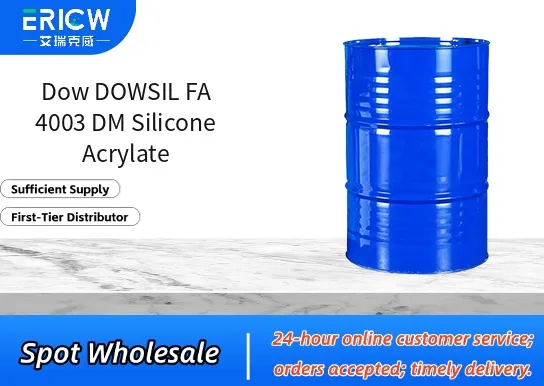
Hybrid silicone-acrylate chemistry enabling balanced performance between silicone softness and acrylate adhesion.
Low-viscosity liquid formulation for easy handling, blending, and compatibility with common acrylic monomers and resins.
UV-curable functionality allowing rapid, solvent-free film formation under standard UV exposure conditions.
Enhanced surface lubricity and mar resistance in cured coatings without compromising clarity or flexibility.
Improved substrate wetting on plastics, metals, and treated films—reducing defects such as cratering or orange peel.
Hard-coat additives for optical films and display cover lenses requiring abrasion resistance and anti-smudge properties.
Functional additive in UV-curable inks for flexible packaging and decorative graphics on polyolefin substrates.
Surface modifier in protective coatings for automotive interior trim and touch-sensitive panels.
Performance enhancer in release liners and low-surface-energy topcoats for adhesive tapes and labels.
Component in high-gloss, durable coatings for consumer electronics housings and wearable device enclosures.
| Chemical Type | Silicone-acrylate hybrid oligomer |
| Product Form | Clear, low-viscosity liquid |
| Appearance | Colorless to pale yellow, transparent liquid |
| Primary Applications | UV-curable coatings, inks, and overprint varnishes |
| Key Features | UV-reactive, silicone-modified, non-volatile |
| Benefits | Enhanced slip, mar resistance, and substrate adhesion |
| Storage Conditions | Store at 15–25 °C; protect from light and moisture |
| Shelf Life | 12 months from date of manufacture when stored properly |
Q1: What is the primary function of DOWSIL FA 4003 DM in coating and ink formulations?
A: DOWSIL FA 4003 DM is a reactive silicone acrylate designed to enhance surface properties—such as slip, mar resistance, and substrate wetting—while covalently bonding into UV-curable or thermally cured acrylic networks. It is not a conventional additive but functions as a polymeric modifier that becomes part of the cured film matrix.
Q2: How does DOWSIL FA 4003 DM differ from non-reactive silicone additives?
A: Unlike non-reactive silicones, which can migrate or bloom over time, DOWSIL FA 4003 DM contains acrylate functional groups that participate in free-radical polymerization. This enables permanent incorporation into the crosslinked network, improving long-term stability of surface effects and reducing compatibility-related defects such as craters or haze.
Q3: Is DOWSIL FA 4003 DM compatible with common UV-curable resin systems?
A: Yes—it demonstrates good compatibility with standard acrylate monomers and oligomers, including urethane acrylates, epoxy acrylates, and polyester acrylates. Compatibility should be verified empirically in the final formulation, particularly when high loadings or sensitive pigments are involved.
Q4: What is the typical dosage range for optimal performance?
A: Dosage depends on the desired surface effect and base formulation, but it is typically used at low concentrations—generally ranging from 0.1% to 2% by weight relative to total solids—to balance performance enhancement with cure efficiency and film integrity.
Q5: Does DOWSIL FA 4003 DM affect cure speed or final hardness in UV-cured films?
A: As a reactive diluent with moderate functionality, it may slightly influence cure kinetics depending on concentration and photoinitiator system. In most cases, it supports efficient curing without significant retardation and contributes to improved flexibility and surface toughness without compromising overall hardness.
Contact With Us:
E-mail: wangxingqiang@ericwchem.com
Have a Questions? Call Us:
Add:
Building A1, Jiete Industrial Park, Huangpu District, Guangzhou City, Guangdong Province, China