English
 Español
 tiếng việt
 русский
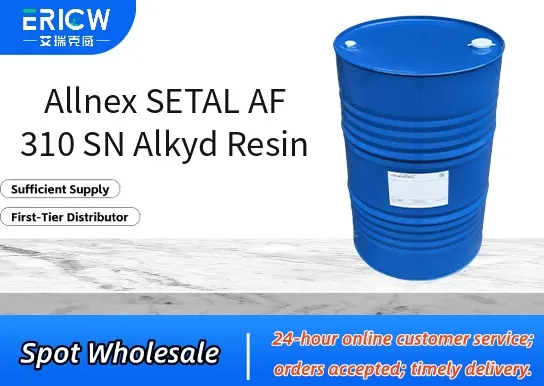
Medium-oil-length alkyd resin based on phthalic anhydride and soybean oil fatty acids.
Designed for excellent gloss retention and long-term durability in ambient-cure coatings.
Offers balanced drying speed and good flow/leveling characteristics for high-quality film formation.
Compatible with common solvents, melamine-formaldehyde resins, and other alkyd-modified systems.
Provides good flexibility and impact resistance in both primers and topcoats.
General-purpose industrial maintenance coatings for metal substrates.
Decorative and protective finishes for agricultural and construction equipment.
Enamels for household appliances and metal furniture.
Undercoat and mid-coat formulations in OEM and refinish applications.
Low-VOC solventborne decorative architectural coatings.
| Chemical Type | Phthalic–soy alkyd resin |
| Product Form | Liquid |
| Appearance | Clear to slightly hazy amber liquid |
| Primary Applications | Ambient-cure industrial enamels and maintenance coatings |
| Key Features | Medium oil length, balanced drying, good compatibility |
| Benefits | Enhanced gloss, flexibility, and substrate adhesion |
| Solvent Compatibility | Compatible with aromatic hydrocarbons, ketones, and esters |
| Storage Stability | Stable under recommended storage conditions (cool, dry, sealed) |
Q1: What is the primary function of SETAL AF 310 SN in coating formulations?
A: SETAL AF 310 SN is a solvent-borne, short-oil alkyd resin designed to act as a reactive binder and rheology modifier—enhancing flow, leveling, and sag resistance while contributing to film build and gloss development in decorative and protective coatings.
Q2: Is SETAL AF 310 SN compatible with common crosslinkers used in ambient-cure systems?
A: Yes, it is formulated to react efficiently with melamine-formaldehyde resins and isothiocyanate-based curing agents under ambient or mild thermal conditions. Compatibility with polyisocyanates should be verified experimentally due to sensitivity to steric and catalytic effects.
Q3: How does SETAL AF 310 SN differ from conventional long-oil alkyds in terms of drying behavior?
A: As a short-oil alkyd, it offers faster through-dry and improved hardness development compared to traditional long-oil types, while retaining good flexibility and adhesion—making it suitable for applications requiring balanced cure speed and mechanical performance.
Q4: Can SETAL AF 310 SN be used in high-solids or low-VOC formulations?
A: It is supplied in aromatic and/or aliphatic hydrocarbon solvents and can be incorporated into medium-to-high solids systems. For low-VOC compliance, formulation adjustments—including solvent selection and potential blending with reactive diluents—may be required to meet regional regulatory targets.
Contact With Us:
E-mail: wangxingqiang@ericwchem.com
Have a Questions? Call Us:
Add:
Building A1, Jiete Industrial Park, Huangpu District, Guangzhou City, Guangdong Province, China