English
 Español
 tiếng việt
 русский
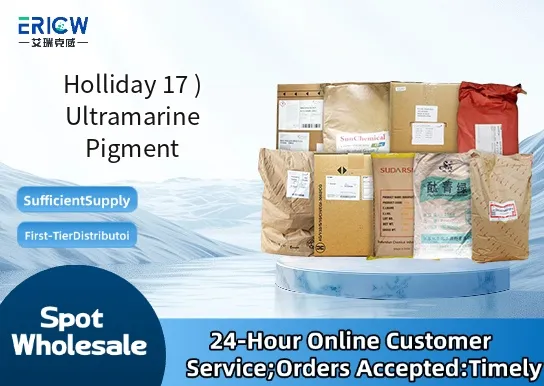
Highly stable synthetic ultramarine blue pigment with exceptional lightfastness and weather resistance.
Non-toxic, sulfate-free formulation compliant with major global regulatory standards for consumer-facing applications.
Excellent dispersion characteristics in both aqueous and solvent-based systems without requiring additional dispersants.
Consistent particle size distribution ensuring uniform color development and minimal batch-to-batch variation.
Alkali-stable up to pH 12, enabling safe use in cementitious, plaster, and high-pH architectural coatings.
Architectural interior and exterior paints for vibrant, fade-resistant blue tones.
Colored concrete, mortars, and precast building elements.
Plastics including polyolefins and PVC for household goods and industrial components.
Inks for packaging and decorative printing where non-bleeding, high-opacity blue is required.
Artist-grade acrylics, gouache, and watercolor formulations demanding archival permanence.
| Chemical Type | Synthetic Sodium Aluminosilicate (Sulfur-containing) |
| Product Form | Fine, free-flowing powder |
| Appearance | Brilliant blue-violet powder with slight violet undertone |
| Primary Applications | Architectural coatings, construction materials, plastics, inks, artists’ colors |
| Key Features | Lightfastness (ISO 105-B02): ≥7, Weather resistance: Excellent, Heat stability: ≤180°C |
| Benefits | No heavy metals, low dust generation, easy wetting, high tinting strength |
| pH Stability Range | 4.0 – 12.0 |
| Volatiles (105°C, 2h) | ≤5.0 wt% |
Q1: What is the primary chemical composition and structural basis of Holliday 17 Ultramarine Pigment?
A: Holliday 17 is a synthetic sodium aluminosilicate pigment with a sulfide-containing sodalite-type crystal lattice. Its intense blue color arises from polysulfide anions (Sₙ²⁻) trapped within the framework, not from transition metals or organic dyes.
Q2: Is Holliday 17 suitable for use in acidic environments or low-pH formulations?
A: No — ultramarine pigments, including Holliday 17, are inherently sensitive to acids. Exposure to pH below approximately 5 may cause irreversible color fading or discoloration due to decomposition of the polysulfide chromophores. It is recommended for neutral to alkaline systems only.
Q3: How does Holliday 17 perform under UV exposure and elevated temperatures?
A: Holliday 17 exhibits good thermal stability up to approximately 250–300 °C in inert or oxidizing atmospheres, but prolonged UV exposure may lead to gradual color weakening, especially in thin films or clear matrices. Stabilization with UV absorbers or co-pigmentation is often employed in demanding outdoor applications.
Q4: Can Holliday 17 be used in food-contact coatings or pharmaceutical packaging inks?
A: Holliday 17 is not approved for direct food-contact applications under major global regulatory frameworks. It is intended for industrial and decorative uses where regulatory compliance for ingestion or migration is not required. Always consult applicable local regulations and obtain full documentation before evaluating suitability for regulated end-uses.
Contact With Us:
E-mail: wangxingqiang@ericwchem.com
Have a Questions? Call Us:
Add:
Building A1, Jiete Industrial Park, Huangpu District, Guangzhou City, Guangdong Province, China