English
 Español
 tiếng việt
 русский
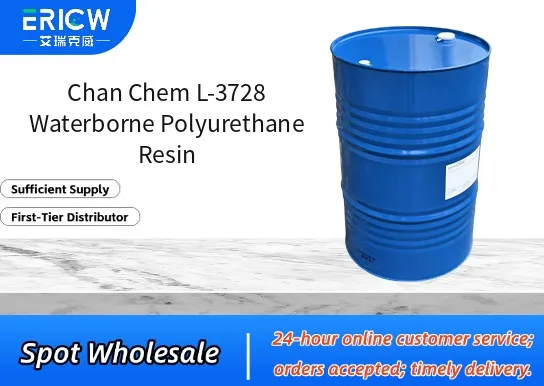
Excellent film-forming capability with high gloss and clarity after drying.
Low VOC content, compliant with stringent environmental regulations for waterborne coatings.
Good compatibility with acrylic emulsions and crosslinkers for hybrid formulation flexibility.
Superior abrasion resistance and flexibility, ideal for demanding protective topcoats.
Stable dispersion in water with extended shelf life (≥12 months at 5–30°C).
Waterborne wood finishes for furniture and flooring.
Industrial maintenance coatings for metal substrates.
Leather finishing topcoats requiring soft hand and hydrolytic stability.
Plastic coating systems for ABS and PC substrates.
High-performance textile coatings for technical fabrics.
| Chemical Type | Anionic aliphatic polyurethane dispersion |
| Product Form | Opaque white liquid |
| Appearance | Homogeneous milky dispersion |
| Solids Content | 30.0 ± 1.0 wt% |
| pH Value | 7.5 – 8.5 |
| Viscosity (Brookfield, RVT, #2 spindle, 25°C) | 50 – 150 cP |
| Density (25°C) | 1.02 – 1.05 g/cm³ |
| Minimum Film Formation Temperature (MFFT) | ≤ 15°C |
Q1: What are the primary application areas for Chan Chem L-3728?
A: Chan Chem L-3728 is widely used in water-based coatings and inks for flexible packaging, paper lamination, and textile finishing, where high film clarity, good flexibility, and strong substrate adhesion are required.
Q2: Is L-3728 compatible with other waterborne resins or additives?
A: Yes, L-3728 demonstrates good compatibility with common waterborne acrylics, styrene-acrylic emulsions, and many standard coalescing agents, defoamers, and rheology modifiers—though compatibility testing under actual formulation conditions is recommended before full-scale use.
Q3: How does L-3728 perform in terms of drying speed and film formation?
A: As a self-crosslinking waterborne polyurethane, L-3728 forms continuous, cohesive films at ambient or moderately elevated temperatures, offering faster dry-to-touch times compared to conventional non-reactive dispersions, especially under controlled humidity and airflow conditions.
Q4: Can L-3728 be used in food-contact compliant formulations?
A: L-3728 is designed for use in systems targeting indirect food contact applications; however, final regulatory compliance depends on the complete formulation, processing conditions, and applicable regional requirements—formulators must conduct full migration and safety assessments as part of their qualification process.
Contact With Us:
E-mail: wangxingqiang@ericwchem.com
Have a Questions? Call Us:
Add:
Building A1, Jiete Industrial Park, Huangpu District, Guangzhou City, Guangdong Province, China