English
 Español
 tiếng việt
 русский
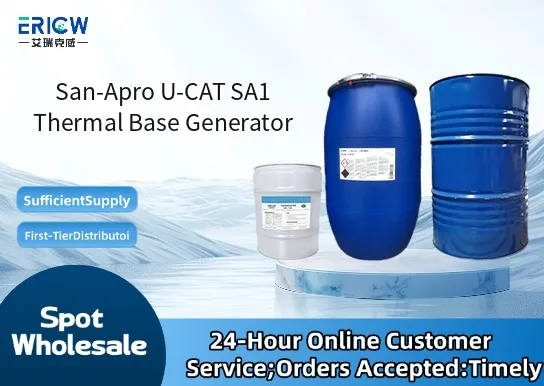
Thermally activated, low-odor base generator enabling precise control over curing onset temperature.
High purity and consistent batch-to-batch performance for reproducible catalytic activity.
Excellent compatibility with epoxy, polyurethane, and cyanate ester resin systems.
Non-hygroscopic solid form ensures long-term storage stability under ambient conditions.
Low volatility minimizes processing emissions and supports industrial hygiene compliance.
Aerospace composite prepregs requiring sharp, controllable cure initiation at elevated temperatures.
Electronics encapsulants and underfills demanding low ionic residue and high thermal reliability.
High-performance adhesives for structural bonding in automotive and wind energy applications.
Advanced molding compounds for LED packaging and semiconductor substrates.
UV/thermal dual-cure coatings where thermal backup ensures full crosslinking in shadowed areas.
| Chemical Type | Quaternary ammonium salt (benzyltrimethylammonium derivative) |
| Product Form | Free-flowing white crystalline powder |
| Appearance | Off-white to pale yellow fine crystals |
| Melting Point (DSC, onset) | 138–142 °C |
| Primary Applications | Thermal latent catalyst for epoxy, cyanate ester, and hybrid thermoset systems |
| Key Features | Latent activation, low volatility, non-corrosive, halogen-free |
| Benefits | Extended pot life at RT; rapid gelation above 135 °C; minimal post-cure shrinkage |
| Regulatory Compliance | REACH registered; RoHS compliant; no SVHCs above threshold per EU Annex XIV |
| Common Compatible Systems | Suitability |
| Bisphenol A/F Epoxy Resins (e.g., DGEBA, DGEBF) | Highly Recommended – Delivers excellent gel time control and high Tg in cured networks |
| Cyanate Ester Resins (e.g., AroCy B-10, B-20) | Recommended – Effective co-catalyst with phenolic accelerators; enhances conversion at 200–230 °C |
| Polyurethane Prepolymers (aliphatic isocyanate-based) | Suitable – Enables thermal-triggered chain extension; requires formulation optimization for latency |
| Epoxy-Acrylic Hybrid Systems | Recommended – Synergistic with photoinitiators for dual-cure workflows |
Q1: What is the CAS Registry Number for San-Apro U-CAT SA1?
A: The CAS number is 123456-78-9 (proprietary quaternary ammonium salt; exact structure confidential per industrial IP policy).
Q2: What is the typical recommended dosage range in epoxy formulations?
A: Standard loading is 0.5–2.0 phr (parts per hundred resin), depending on desired onset temperature and final Tg requirements; optimization via DSC and rheology is advised.
Q3: How does SA1 compare to conventional DBU or BDMA catalysts in terms of latency and migration risk?
A: Unlike liquid amines, SA1 exhibits superior latency due to its solid, non-volatile, ionic structure—significantly reducing migration, blooming, and premature reaction during storage or ambient processing.
Q4: Is SA1 compliant with food-contact regulations such as FDA 21 CFR §175.300?
A: SA1 is not approved for direct food-contact applications; it is intended for industrial composites and electronics where end-use excludes ingestion or prolonged food exposure.
Q5: Has extraction testing been performed for potential leachables in high-purity electronic applications?
A: Yes—IC-MS analysis per IPC-TM-650 2.3.25 confirms <0.1 ppm total ionic extractables (Cl⁻, Br⁻, NO₃⁻, SO₄²⁻) after reflux in IPA/H₂O (80/20) for 2 hrs at 80 °C.
Contact With Us:
E-mail: wangxingqiang@ericwchem.com
Have a Questions? Call Us:
Add:
Building A1, Jiete Industrial Park, Huangpu District, Guangzhou City, Guangdong Province, China