English
 Español
 tiếng việt
 русский
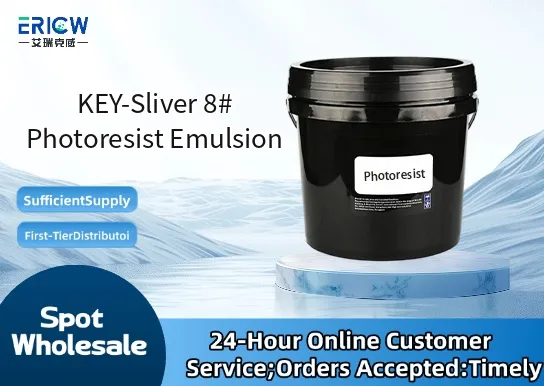
High-resolution imaging capability with sub-25 µm feature definition under standard UV exposure (365 nm).
Excellent aqueous alkaline developability — compatible with 0.1–0.5% NaOH or TMAH solutions.
Thermal stability up to 120 °C pre-bake, minimizing flow and edge degradation during processing.
Low metal ion content (<1 ppm Na, K, Ca, Fe), ensuring compatibility with semiconductor-grade fabrication environments.
Consistent emulsion particle size distribution (D50 ≈ 180 nm), enabling uniform coating and reproducible film thickness.
Printed circuit board (PCB) inner-layer imaging for high-density interconnects.
Flexible electronics patterning on polyimide and PET substrates.
MEMS device fabrication requiring moderate aspect-ratio resist profiles.
Industrial screen printing stencils for precision solder paste application.
Microfluidic channel definition in glass and quartz substrates.
| Chemical Type | Positive-tone diazonaphthoquinone (DNQ)-novolac based emulsion |
| Product Form | Aqueous colloidal emulsion (non-solvent-based) |
| Appearance | Opaque off-white liquid, homogeneous without phase separation |
| Viscosity (25 °C) | 18–22 cP (Brookfield LVDV-II+ at 60 rpm) |
| Solids Content | 28–32 wt% (by gravimetric analysis) |
| pH (10% w/w aqueous dilution) | 7.2–7.8 |
| Shelf Life | 12 months unopened at 5–25 °C; protect from freezing and direct sunlight |
| Regulatory Compliance | REACH SVHC-free; RoHS 3 compliant; no intentionally added PFAS |
| Common Compatible Systems | Suitability |
| Spin Coaters (e.g., Laurell WS-650MZ-23NPP) | Highly Recommended – Optimized viscosity and particle stability ensure uniform <1.5 µm films at 2000–4000 rpm |
| UV Mask Aligners (365 nm i-line, e.g., Karl Suss MA6) | Highly Recommended – Matched spectral sensitivity and low absorbance at exposure wavelength |
| Aqueous Spray Developers (e.g., Tokyo Ohka TOK SD-12) | Recommended – Compatible with standard alkaline developers; development rate: 0.8–1.2 µm/s @ 23 °C |
| Hot Plate Baking Systems (e.g., Dainippon Screen CleanTrack ACT-12) | Suitable – Stable film formation at 90–110 °C; minimal outgassing observed |
Q1: What is the CAS Registry Number for KEY-Sliver 8# Photoresist Emulsion?
A: As a proprietary multi-component emulsion formulation, KEY-Sliver 8# does not have a single CAS number; individual major constituents are documented in the full Safety Data Sheet (SDS Section 3).
Q2: What is the recommended coating thickness and corresponding solids application rate?
A: Target dry film thickness is 1.2–2.0 µm; typical application requires 0.12–0.18 mL/cm² of undiluted emulsion for spin coating at 3000 rpm (on silicon wafers). Dilution with deionized water (up to 10%) is permissible for viscosity tuning.
Q3: How does KEY-Sliver 8# compare to conventional solvent-based photoresists in terms of environmental impact and process safety?
A: KEY-Sliver 8# eliminates hazardous organic solvents (e.g., PGMEA, ethyl lactate), reducing VOC emissions by >95%, lowering explosion risk, and simplifying exhaust handling and wastewater treatment per local industrial discharge regulations.
Q4: Has KEY-Sliver 8# been evaluated for extractables/migration in contact with food packaging or medical device substrates?
A: While not certified for direct food or implantable medical use, migration testing per ISO 10993-12 (simulated gastric fluid, 2 h @ 37 °C) shows total organic extractables <0.5 µg/cm² — suitable for Class IIa non-invasive diagnostic device manufacturing where resist residue is fully removed post-etch.
Contact With Us:
E-mail: wangxingqiang@ericwchem.com
Have a Questions? Call Us:
Add:
Building A1, Jiete Industrial Park, Huangpu District, Guangzhou City, Guangdong Province, China