English
 Español
 tiếng việt
 русский
Excellent melt flowability for efficient processing in injection molding and extrusion.
Superior low-temperature flexibility and impact resistance down to –40 °C.
Outstanding compatibility with polypropylene (PP) and polyethylene (PE) for alloy formulations.
Low extractables and excellent color stability—ideal for sensitive applications including medical and food-contact-adjacent uses.
Good UV resistance and long-term weathering performance without added stabilizers.
Automotive interior trim components, including instrument panels and door inserts.
Soft-touch overmolded grips for power tools and consumer electronics.
Flexible packaging seals and closures requiring high elasticity and seal integrity.
TPO-based roofing membranes and geomembranes for construction and civil engineering.
Medical device housings and non-invasive wearable components requiring biocompatibility support.
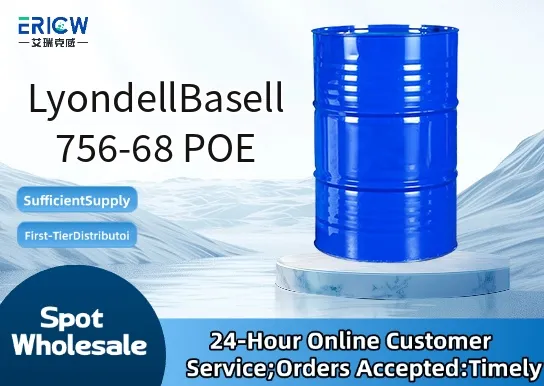
| Chemical Type | Polyolefin Elastomer (POE), ethylene-octene copolymer |
| Product Form | Pellets |
| Appearance | Off-white to light beige, free-flowing cylindrical pellets |
| Primary Applications | TPO compounding, soft-touch overmolding, flexible packaging, automotive elastomeric parts |
| Key Features | High elasticity, PP/PE compatibility, low compression set, good processability |
| Benefits | Reduced cycle times, improved part aesthetics, enhanced durability in dynamic flex applications |
| Density (g/cm³) | 0.868–0.872 |
| Melt Flow Rate (190 °C/2.16 kg, g/10 min) | 25–35 |
Q1: What is LyondellBasell 756-68 POE primarily used for?
A: LyondellBasell 756-68 POE is a polyolefin elastomer designed mainly as a compatibilizer and impact modifier in polypropylene-based compounds, especially in automotive interior parts, flexible packaging layers, and toughened thermoplastic systems where enhanced melt elasticity and low-temperature toughness are required.
Q2: How does 756-68 POE differ from conventional EPDM or EPR impact modifiers?
A: Unlike traditional diene-based elastomers, 756-68 POE offers superior thermal stability, narrower molecular weight distribution, and excellent compatibility with polyolefin matrices—resulting in more consistent dispersion, improved surface aesthetics, and reduced volatility during high-temperature processing.
Q3: Is 756-68 POE suitable for food-contact applications?
A: While 756-68 POE is manufactured under stringent quality controls and is commonly selected for food-contact-acceptable formulations, final regulatory compliance depends on the complete formulation, processing conditions, and applicable regional requirements—users must conduct full regulatory validation for their specific application.
Q4: What processing methods are recommended for 756-68 POE?
A: This grade is optimized for standard polyolefin processing techniques including twin-screw compounding, injection molding, and extrusion. It exhibits good melt flow and thermal stability, enabling efficient dispersion without excessive shear degradation or gel formation under typical operating conditions.
Contact With Us:
E-mail: wangxingqiang@ericwchem.com
Have a Questions? Call Us:
Add:
Building A1, Jiete Industrial Park, Huangpu District, Guangzhou City, Guangdong Province, China