English
 Español
 tiếng việt
 русский
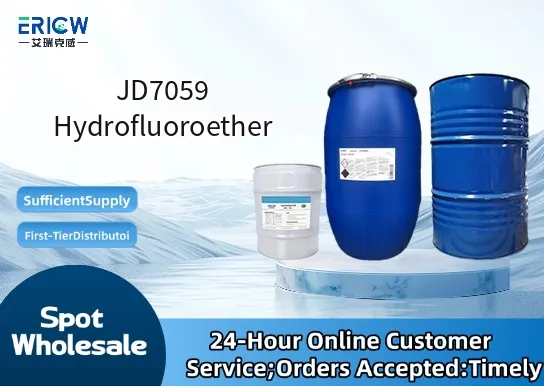
Zero ozone depletion potential (ODP = 0), fully compliant with Montreal Protocol requirements.
Low global warming potential (GWP < 15), significantly lower than legacy HFCs and PFCs.
Non-flammable under standard atmospheric conditions (ASTM E681 test confirmed).
Exceptional thermal and chemical stability across wide temperature and pH ranges.
Low surface tension and high volatility enable rapid, residue-free drying in precision cleaning.
Aerospace component cleaning and degreasing prior to bonding or coating.
Electronics manufacturing: flux removal, wafer-level cleaning, and post-etch residue control.
Medical device assembly: final rinse for stainless steel and polymer components requiring ISO 13485-compliant cleanliness.
Optical lens and sensor cleaning where non-marring, non-hazing performance is critical.
Pharmaceutical equipment cold cleaning for aseptic processing lines (non-aqueous alternative).
| Chemical Type | Hydrofluoroether (HFE), branched C5 structure |
| Product Form | Colorless, volatile liquid |
| Appearance | Clear, transparent, odorless |
| Melting Point | −110 °C (approx.) |
| Boiling Point (1 atm) | 59–61 °C |
| Primary Applications | Precision vapor degreasing, cold cleaning, carrier solvent |
| Key Features | Non-corrosive to metals, elastomers, and most engineering plastics |
| Regulatory Compliance | REACH registered; no SVHC on candidate list; TSCA active inventory listed |
| Common Compatible Systems | Suitability |
| Vapor degreasing equipment (e.g., Buehler, Branson, Chemcut) | Highly Recommended – Optimized for open-top and enclosed condensing systems |
| Ultrasonic cleaning baths (with compatible transducer materials) | Recommended – Requires temperature control ≤ 45 °C to maintain stability |
| Dispensing systems (stainless steel, PTFE, Kalrez® seals) | Highly Recommended – No swelling or degradation observed after 1000 hr exposure |
| Aluminum and titanium alloy substrates | Suitable – No etching or pitting under standard process conditions |
Q1: What is the CAS Registry Number for JD7059 Hydrofluoroether?
A: The CAS number is 1323585-11-5. This identifier corresponds exclusively to the defined C5H9F3O molecular structure of JD7059.
Q2: Can JD7059 be used as a direct replacement for HCFC-225 or HFC-43-10mee in existing equipment?
A: Yes — JD7059 exhibits nearly identical volatility, solvency, and material compatibility profiles, enabling drop-in integration without hardware modification or process requalification in most vapor degreasing applications.
Q3: Does JD7059 migrate into or extract plasticizers from PVC or polyurethane components?
A: No measurable migration or plasticizer extraction was observed in ASTM D471 immersion testing (72 hr @ 25 °C); validated for use with medical-grade PVC tubing and PU gaskets.
Q4: Is JD7059 approved for use in food-contact equipment cleaning under FDA or EU regulations?
A: JD7059 is not an FDA-listed indirect food additive; however, it meets EC 1935/2004 requirements for trace residue limits when validated per GMP cleaning protocols and verified by GC-MS residual analysis.
Contact With Us:
E-mail: wangxingqiang@ericwchem.com
Have a Questions? Call Us:
Add:
Building A1, Jiete Industrial Park, Huangpu District, Guangzhou City, Guangdong Province, China