English
 Español
 tiếng việt
 русский
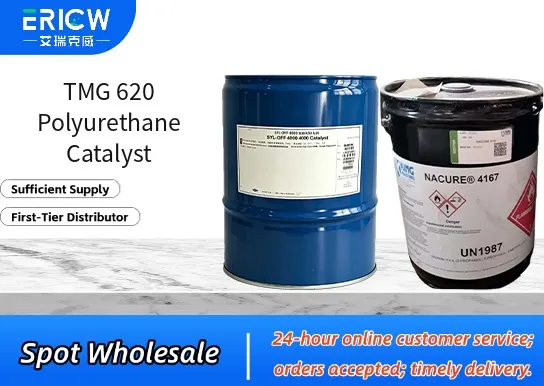
Highly selective tertiary amine catalyst optimized for polyurethane foam systems.
Excellent balance of cream, gel, and tack-free times in flexible slabstock and molded foam formulations.
Low volatility and reduced odor profile compared to traditional amine catalysts.
Good compatibility with common polyols, isocyanates, and other formulation additives.
Stable performance across a wide range of processing temperatures and humidity conditions.
Flexible polyurethane slabstock foam for bedding and furniture.
Automotive interior foams including seat cushions and headrests.
Molded flexible PU foam parts for industrial and consumer goods.
High-resilience (HR) foam formulations requiring precise reactivity control.
Water-blown and low-VOC foam systems targeting regulatory compliance.
| Chemical Type | Tertiary amine |
| Product Form | Liquid |
| Appearance | Clear, pale yellow liquid |
| Primary Applications | Flexible polyurethane foam catalysis |
| Key Features | Reactivity balancing, low odor, thermal stability |
| Benefits | Improved processing window, enhanced foam uniformity, reduced emissions |
| Density (25°C) | ~0.92–0.94 g/cm³ |
| Flash Point (COC) | ≥110°C |
Q1: What is the primary function of TMG 620 in polyurethane systems?
A: TMG 620 is a highly selective tertiary amine catalyst that primarily promotes the urethane reaction (isocyanate–polyol coupling), enabling improved flow, reduced demold times, and enhanced surface quality in flexible and rigid foams, as well as cast elastomers.
Q2: Is TMG 620 compatible with moisture-sensitive or low-emission formulations?
A: Yes — TMG 620 exhibits low volatility and minimal odor, making it suitable for low-VOC and indoor-applicable PU systems. It does not significantly accelerate the water–isocyanate side reaction, supporting better control over foam rise and cell structure in sensitive applications.
Q3: How should TMG 620 be handled and stored to maintain stability?
A: Store in tightly sealed original containers under dry, cool conditions (below 30 °C) and protected from direct sunlight. Avoid prolonged exposure to air or moisture, as it may gradually absorb CO₂ and form carbamates, potentially affecting catalytic activity over time.
Q4: Can TMG 620 be used in combination with other catalysts?
A: Yes — TMG 620 is commonly blended with gelling catalysts (e.g., DABCO® T-9 analogues) or blowing catalysts to fine-tune reactivity balance. Compatibility should be verified experimentally per formulation, as synergistic or inhibitory effects may occur depending on system composition.
Q5: What types of polyurethane applications benefit most from TMG 620’s selectivity?
A: Applications requiring precise control over gel time versus blow time — such as high-resilience slabstock foams, microcellular elastomers, and structural reaction injection molding (RIM) — benefit significantly from TMG 620’s strong urethane-selective activity and reduced sensitivity to formulation variability.
Contact With Us:
E-mail: wangxingqiang@ericwchem.com
Have a Questions? Call Us:
Add:
Building A1, Jiete Industrial Park, Huangpu District, Guangzhou City, Guangdong Province, China