English
 Español
 tiếng việt
 русский
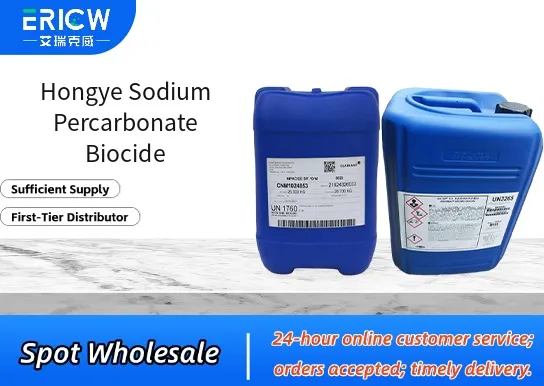
Highly effective broad-spectrum biocidal activity against bacteria, fungi, yeasts, and spores.
Environmentally compatible—decomposes into sodium carbonate, water, and oxygen upon dissolution.
Stable in solid form with extended shelf life under dry, cool storage conditions.
Non-chlorine-based oxidizing biocide, avoiding formation of harmful chlorinated by-products.
Compatible with common industrial water treatment formulations and non-corrosive to stainless steel and plastics.
Cooling water systems in HVAC and power generation facilities.
Process water disinfection in food & beverage production lines.
Sanitization of membranes and RO systems in water purification plants.
Biofilm control in pulp and paper mill white water circuits.
Preservation of aqueous-based industrial formulations (e.g., metalworking fluids, paints, adhesives).
| Chemical Type | Sodium percarbonate (2Na₂CO₃·3H₂O₂) |
| Product Form | Free-flowing crystalline powder |
| Appearance | White to off-white granules or fine crystals |
| Active Oxygen Content | ≥13.0% (w/w) |
| Moisture Content | ≤5.0% (w/w) |
| pH (1% aqueous solution) | 10.2–10.8 |
| Primary Applications | Industrial water treatment, sanitation, and preservative stabilization |
| Key Features | Oxidizing biocide, non-toxic decomposition pathway, low environmental impact |
Q1: What is the primary mode of action of Hongye Sodium Percarbonate Biocide?
A: It functions as an oxidative biocide through controlled release of hydrogen peroxide and active oxygen upon dissolution in water, effectively disrupting microbial cell membranes and metabolic pathways.
Q2: Is this product suitable for use in rinse-off personal care formulations?
A: Yes, it is commonly used in oxidizing cleansing systems such as toothpaste, mouthwash, and whitening gels where controlled antimicrobial activity and compatibility with common surfactants and thickeners are required.
Q3: How should Hongye Sodium Percarbonate Biocide be stored to maintain stability?
A: Store in a cool, dry place below 30°C, in tightly sealed original packaging away from moisture, direct sunlight, and reducing agents to prevent premature decomposition.
Q4: Can it be used in combination with other preservatives?
A: Yes, it is often formulated synergistically with non-oxidative preservatives to broaden antimicrobial spectrum and improve shelf-life performance—compatibility testing under actual formulation conditions is recommended.
Contact With Us:
E-mail: wangxingqiang@ericwchem.com
Have a Questions? Call Us:
Add:
Building A1, Jiete Industrial Park, Huangpu District, Guangzhou City, Guangdong Province, China