English
 Español
 tiếng việt
 русский
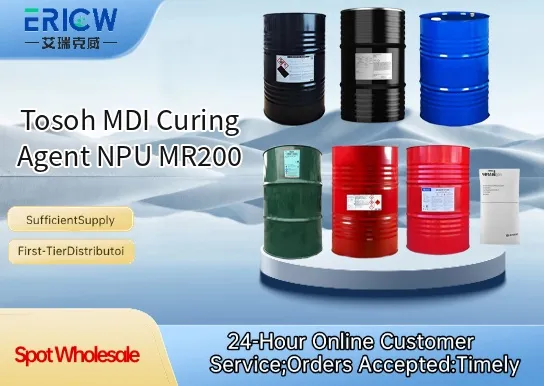
High reactivity with polyols and amines for rapid gelation and reduced cycle times.
Excellent hydrolytic stability due to pure 4,4'-MDI backbone with minimal carbamate impurities.
Low volatility and low vapor pressure, enhancing workplace safety and handling consistency.
Precision-controlled isocyanate functionality (NCO content ≈ 33.5–33.8 wt%) for predictable stoichiometry.
Optimized for low-fogging performance in automotive interior applications.
Automotive interior trim foams (e.g., headliners, door panels, armrests).
High-resilience flexible slabstock polyurethane foams.
Reaction injection molding (RIM) systems for structural components.
Microcellular elastomers requiring fine cell structure and dimensional stability.
Industrial sealants and adhesives demanding fast green strength development.
| Chemical Type | 4,4'-Diphenylmethane diisocyanate (4,4'-MDI), purified monomeric grade |
| Product Form | Liquid |
| Appearance | Clear, pale yellow to amber liquid |
| NCO Content (wt%) | 33.5–33.8 |
| Viscosity at 25°C (mPa·s) | 15–25 |
| Acidity (as HCl, wt%) | ≤ 0.005 |
| Water Content (wt%) | ≤ 0.02 |
| Storage Stability | Stable under nitrogen blanket at ≤ 30°C for ≥ 12 months |
Q1: What is the primary function of NPU MR200 in polyurethane systems?
A: NPU MR200 is a modified MDI-based curing agent designed to enhance crosslink density and improve thermal stability, mechanical strength, and chemical resistance in thermosetting polyurethane coatings, adhesives, and elastomers.
Q2: Is NPU MR200 compatible with common polyol types used in industrial PU formulations?
A: Yes, NPU MR200 demonstrates broad compatibility with polyester polyols, polyether polyols, and polycarbonate diols. Reactivity and final film properties may vary depending on polyol functionality, molecular weight, and formulation pH or moisture content.
Q3: How should NPU MR200 be handled and stored to maintain optimal reactivity?
A: Store in tightly sealed containers under dry, inert atmosphere (e.g., nitrogen blanket) at temperatures between 15–30 °C. Avoid exposure to moisture, ambient humidity, or elevated temperatures during storage or handling, as this may lead to premature dimerization or viscosity increase.
Q4: Can NPU MR200 be used in low-VOC or high-solids PU coating systems?
A: Yes — its low volatility and high functionality make it well-suited for low-VOC and high-solids applications. It enables reduced solvent demand while supporting robust film formation and cure performance without significant outgassing or blistering.
Contact With Us:
E-mail: wangxingqiang@ericwchem.com
Have a Questions? Call Us:
Add:
Building A1, Jiete Industrial Park, Huangpu District, Guangzhou City, Guangdong Province, China