English
 Español
 tiếng việt
 русский
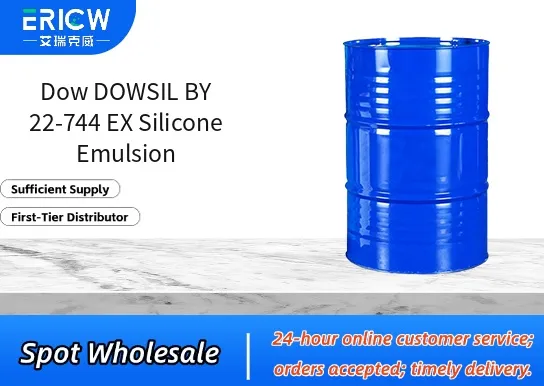
Highly stable, anionic silicone emulsion designed for easy incorporation into aqueous systems.
Provides excellent lubricity and surface slip without compromising adhesion in coating formulations.
Offers good compatibility with common water-based polymers, surfactants, and thickeners.
Delivers durable hydrophobicity and soft-touch feel on treated substrates.
Low foaming profile suitable for high-shear processing and industrial coating lines.
Textile finishing for enhanced hand feel, wrinkle resistance, and fabric softness.
Leather finishing to improve grain clarity, flexibility, and water repellency.
Water-based architectural coatings for improved leveling and substrate wetting.
Industrial maintenance coatings requiring reduced surface friction and improved abrasion resistance.
Nonwoven treatment for hydrophobic barrier enhancement and tactile refinement.
| Chemical Type | Anionic polydimethylsiloxane (PDMS) emulsion |
| Product Form | Aqueous emulsion |
| Appearance | Opaque white to off-white liquid |
| pH (1% aqueous solution) | 5.0 – 7.0 |
| Active Content (wt%) | 25.0 – 27.0% |
| Viscosity (mPa·s, Brookfield RVT, #2 spindle, 20 rpm) | 50 – 200 |
| Freeze-Thaw Stability | Stable after one cycle (–10 °C for 16 h, then 23 °C for 8 h) |
| Recommended Storage Temperature | 5 – 35 °C |
Q1: What is the primary function of DOWSIL BY 22-744 EX in coating and ink formulations?
A: DOWSIL BY 22-744 EX is a non-ionic silicone emulsion designed to provide surface leveling, slip enhancement, and reduced surface tension in water-based coatings, inks, and overprint varnishes. It helps minimize defects such as orange peel, craters, and pinholes while improving substrate wetting and gloss uniformity.
Q2: Is DOWSIL BY 22-744 EX compatible with common water-based acrylic and polyurethane dispersions?
A: Yes, it demonstrates good compatibility with a broad range of waterborne polymer systems, including acrylics, styrene-acrylics, and aliphatic polyurethane dispersions. Compatibility should be verified under actual formulation conditions, especially when high shear or elevated temperatures are involved.
Q3: How should DOWSIL BY 22-744 EX be incorporated into a formulation?
A: It is typically added during the let-down or post-addition stage, after the main binder and pigments have been dispersed. Gentle mixing is recommended to avoid excessive foaming. Pre-dilution with water may improve dispersion in sensitive systems, and addition at ambient temperature is preferred.
Q4: Does DOWSIL BY 22-744 EX affect film clarity or yellowing in clear coatings?
A: When used within recommended dosage levels, it generally maintains optical clarity and does not contribute to yellowing in clear, water-based systems. Its non-ionic nature and low volatility support long-term stability without compromising transparency or lightfastness.
Contact With Us:
E-mail: wangxingqiang@ericwchem.com
Have a Questions? Call Us:
Add:
Building A1, Jiete Industrial Park, Huangpu District, Guangzhou City, Guangdong Province, China