English
 Español
 tiếng việt
 русский
High reactivity with standard bisphenol-A and bisphenol-F epoxy resins.
Enables fast ambient-cure formulations without external heat input.
Delivers excellent chemical resistance, particularly to alkalis and solvents.
Low viscosity improves blend homogeneity and facilitates processing in automated systems.
Non-blushing formulation ensures superior surface aesthetics in clear-coat applications.
Industrial flooring systems requiring rapid return-to-service.
Electrical encapsulation and potting of power electronics and transformers.
High-performance adhesives for metal, composite, and concrete bonding.
Protective coatings for marine and offshore infrastructure.
Composite matrix resins for wind turbine blade manufacturing.
| Chemical Type | Aliphatic polyamine adduct |
| Product Form | Liquid |
| Appearance | Pale yellow to amber clear liquid |
| Density (20 °C) | 0.94–0.96 g/cm³ |
| Viscosity (25 °C) | 250–450 mPa·s |
| Amine Value | 280–320 mg KOH/g |
| Reactivity Profile | Fast ambient cure (tack-free in ≤4 h at 23 °C / 50% RH) |
| Primary Applications | Structural adhesives, protective coatings, electrical encapsulation |
Q1: What is the primary chemical class of Epoxy Curing Agent 2753?
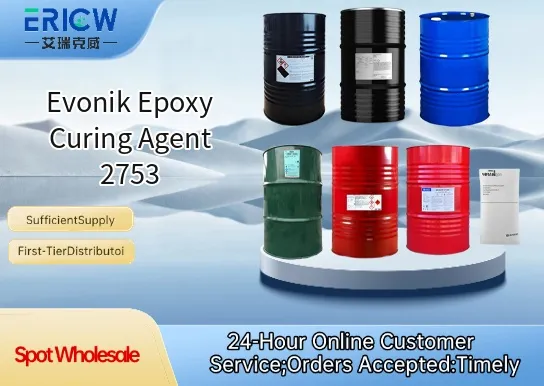
A: Evonik Epoxy Curing Agent 2753 is a modified aliphatic amine-based curing agent, engineered for enhanced reactivity control and reduced volatility compared to conventional amines.
Q2: Is this curing agent suitable for low-VOC or high-solids epoxy formulations?
A: Yes — its low vapor pressure and compatibility with solvent-free and high-solids systems make it well-suited for environmentally compliant coatings and adhesives where VOC reduction is a key objective.
Q3: How does Epoxy Curing Agent 2753 influence pot life and cure speed relative to standard DETA or DEEDA?
A: It offers extended pot life at ambient temperatures while enabling faster through-cure under mild thermal conditions, providing improved processing flexibility for industrial coating and composite applications.
Q4: Can it be used in food-contact or potable water applications?
A: While not pre-approved for direct food contact, it may be incorporated into formulations that comply with relevant regional regulatory frameworks — final compliance must be verified by the formulator based on full system testing and intended end-use conditions.
Contact With Us:
E-mail: wangxingqiang@ericwchem.com
Have a Questions? Call Us:
Add:
Building A1, Jiete Industrial Park, Huangpu District, Guangzhou City, Guangdong Province, China