English
 Español
 tiếng việt
 русский
Highly selective hydrogenation catalyst optimized for removal of alkynes and dienes in C₂–C₄ streams.
Exceptional stability under industrial hydroprocessing conditions, minimizing deactivation and extending cycle life.
Low palladium loading with proprietary support matrix, delivering cost-effective performance without compromising activity.
Designed for fixed-bed reactor operation with excellent mechanical strength and crush resistance.
Sulfur-tolerant formulation enabling reliable operation in feedstocks with trace sulfur contaminants.
Ethylene purification units for polymer-grade ethylene production.
Propylene refining in polypropylene and acrylonitrile feedstock preparation.
C₄ fraction selective hydrogenation in butadiene recovery and raffinate processing.
Front-end hydrogenation in steam cracker off-gas treatment systems.
Refinery light ends upgrading for petrochemical feedstock conditioning.
| Chemical Type | Palladium-based heterogeneous catalyst on modified alumina support |
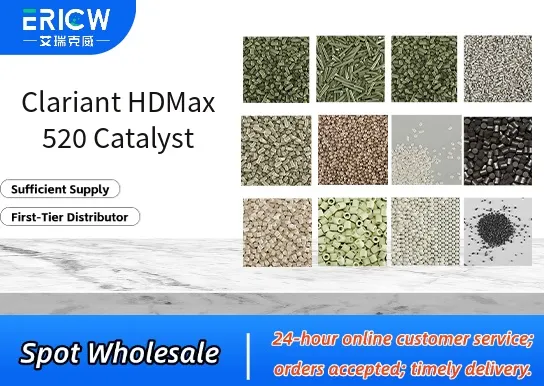
| Product Form | Cylindrical extrudates (3 mm diameter × 3–6 mm length) |
| Appearance | Gray-black solid pellets |
| Primary Applications | Selective hydrogenation of alkynes and dienes in olefinic streams |
| Key Features | High selectivity, low Pd loading, sulfur tolerance, thermal stability |
| Benefits | Extended run lengths, reduced catalyst consumption, improved product purity |
| Storage Requirement | Store in dry, inert atmosphere; avoid exposure to air and moisture |
Q1: What is the primary function of HDMax 520 in polyolefin processing?
A: HDMax 520 is a high-performance peroxide decomposition catalyst designed to selectively neutralize residual peroxides in polyolefin compounds—especially in crosslinked polyethylene (PEX) and thermoplastic elastomer (TPE) formulations—thereby improving long-term thermal stability and preventing premature degradation during extrusion or post-processing.
Q2: How does HDMax 520 differ from conventional metal stearate catalysts?
A: Unlike traditional metal stearates, HDMax 520 features a tailored organometallic structure that offers enhanced selectivity for peroxide residues without promoting undesirable side reactions—such as discoloration or gel formation—and demonstrates improved compatibility with sensitive polymer matrices and additive packages.
Q3: Is HDMax 520 suitable for food-contact or potable water applications?
A: HDMax 520 is formulated to meet general regulatory expectations for indirect food contact and potable water systems when used within recommended dosage ranges and processed under standard industrial conditions; however, final compliance depends on full system evaluation—including polymer grade, processing parameters, and end-use requirements—as determined by the compounder or end-user.
Q4: What is the typical dosage range for HDMax 520 in polyolefin compounds?
A: Dosage is formulation-dependent but generally ranges from 0.1% to 2% by weight relative to the base polymer, with optimal performance often achieved at lower concentrations when combined with appropriate peroxide initiation systems and thermal history control.
Q5: Can HDMax 520 be added directly during extrusion, or is pre-compounding required?
A: HDMax 520 is highly compatible with standard melt-processing equipment and can be introduced either via masterbatch pre-compounding or direct feeding into the extruder—particularly at the final zone—provided uniform dispersion and controlled residence time are maintained to ensure consistent peroxide scavenging efficiency.
Contact With Us:
E-mail: wangxingqiang@ericwchem.com
Have a Questions? Call Us:
Add:
Building A1, Jiete Industrial Park, Huangpu District, Guangzhou City, Guangdong Province, China