English
 Español
 tiếng việt
 русский
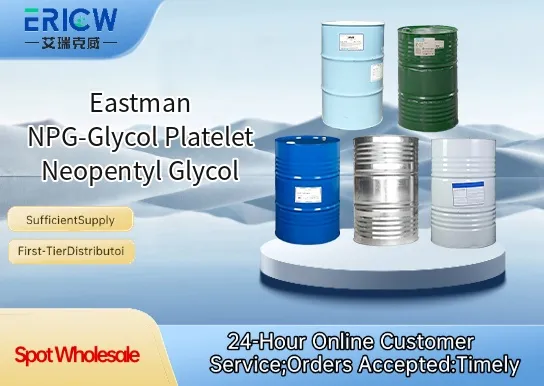
High-purity crystalline platelet morphology ensures excellent flowability and uniform dispersion in solid resin systems.
Exceptional hydrolytic stability due to the sterically hindered neopentyl structure, minimizing ester degradation during processing and service life.
Low volatility and high melting point (≥128 °C) support thermal stability in high-temperature curing applications.
Reactive diol functionality enables robust crosslinking in polyester, alkyd, and polyurethane resins.
Consistent batch-to-batch quality certified under Eastman’s ISO 9001–compliant manufacturing system.
Powder coating resins for architectural and appliance finishes requiring weather resistance and gloss retention.
High-performance alkyd enamels used in industrial maintenance and marine coatings.
Crosslinkers in thermosetting polyester molding compounds (SMC/BMC) for automotive and electrical components.
Monomer building block in specialty polyurethane dispersions (PUDs) for eco-friendly leather and textile coatings.
Stabilizing diol in UV-curable acrylate formulations demanding low shrinkage and high hardness.
| Chemical Type | Neopentyl glycol (2,2-dimethyl-1,3-propanediol) |
| Product Form | Free-flowing white crystalline platelets |
| Appearance | White, odorless crystalline solid |
| Melting Point | 128–132 °C (ASTM D2117) |
| Purity (GC) | ≥99.5% (neopentyl glycol) |
| Moisture Content | ≤0.10 wt% (Karl Fischer) |
| Acid Number | ≤0.1 mg KOH/g (ASTM D974) |
| Color (APHA) | ≤20 (10% w/w in water) |
Contact With Us:
E-mail: wangxingqiang@ericwchem.com
Have a Questions? Call Us:
Add:
Building A1, Jiete Industrial Park, Huangpu District, Guangzhou City, Guangdong Province, China