English
 Español
 tiếng việt
 русский
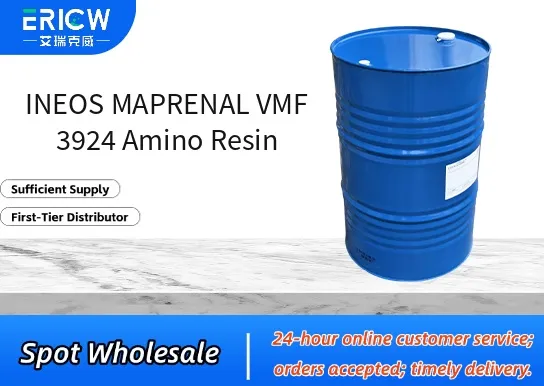
High reactivity with melamine-formaldehyde and urea-formaldehyde systems for rapid cure kinetics.
Excellent compatibility with alkyd, polyester, and acrylic resins in thermosetting coatings.
Low formaldehyde emission profile, supporting compliance with stringent VOC and emissions regulations.
Superior gloss retention and chemical resistance in baked industrial finishes.
Consistent batch-to-batch performance due to tightly controlled polymerisation process.
Automotive OEM and refinish topcoats requiring high durability and appearance.
Industrial coil coatings for pre-painted metal substrates.
Appliance finishes demanding excellent hardness and mar resistance.
General-purpose can coatings for food and beverage containers.
Wood furniture and panel coatings requiring fast oven cure cycles.
| Chemical Type | Melamine-formaldehyde crosslinker |
| Product Form | Clear, low-viscosity liquid |
| Appearance | Colorless to pale yellow, homogeneous liquid |
| Non-Volatile Content (wt%) | 80–84% (at 135°C, 60 min) |
| Viscosity (mPa·s, 25°C) | 1,200–2,000 |
| Acid Number (mg KOH/g) | < 5.0 |
| Water Solubility | Partially miscible; stable in alcohol/water blends |
| Storage Stability | ≥ 6 months at 20–25°C in sealed container |
Q1: What is the primary function of INEOS MAPRENAL VMF 3924 in coating formulations?
A: INEOS MAPRENAL VMF 3924 is a melamine-formaldehyde amino resin designed to act as a crosslinking agent for thermosetting resins—particularly hydroxyl-functional acrylics, alkyds, and polyesters. It enhances hardness, chemical resistance, and thermal stability upon cure.
Q2: Is VMF 3924 suitable for low-bake or ambient-cure systems?
A: VMF 3924 is formulated for conventional thermal curing, typically requiring baking temperatures between 120 °C and 160 °C. While it can be used in some low-bake applications with appropriate catalysts, it is not optimized for true ambient-cure systems without significant formulation adaptation.
Q3: How does VMF 3924 compare to other melamine resins in terms of compatibility and storage stability?
A: VMF 3924 offers good compatibility with common solvent-based and high-solids binder systems, and demonstrates enhanced storage stability compared to highly reactive, high-methylol melamines—especially under controlled pH and moisture conditions.
Q4: What catalysts are commonly recommended for use with VMF 3924?
A: Acidic catalysts such as p-toluenesulfonic acid (p-TSA), blocked sulfonic acids, or weak organic acids are frequently employed to accelerate the crosslinking reaction. Catalyst selection and dosage depend on the desired pot life, cure schedule, and final film performance requirements.
Q5: Can VMF 3924 be used in waterborne coatings?
A: VMF 3924 is supplied in organic solvents and is primarily intended for solvent-borne or high-solids systems. For waterborne applications, careful emulsification or co-solvent adjustment may be required, but dedicated water-dispersible melamine alternatives are generally preferred for robust stability and performance.
Contact With Us:
E-mail: wangxingqiang@ericwchem.com
Have a Questions? Call Us:
Add:
Building A1, Jiete Industrial Park, Huangpu District, Guangzhou City, Guangdong Province, China