English
 Español
 tiếng việt
 русский
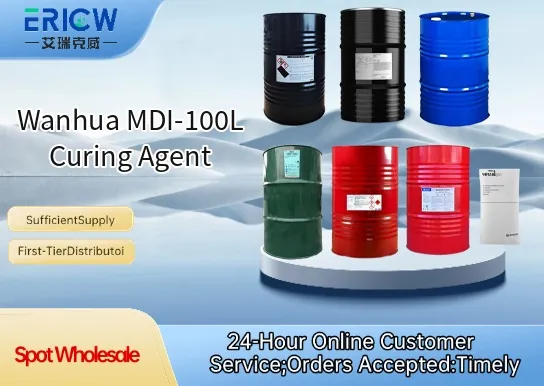
Low-viscosity liquid MDI-based curing agent for enhanced processability and easy handling.
Excellent compatibility with polyol systems, enabling uniform dispersion and stable formulation.
Controlled reactivity profile suitable for both ambient-cure and forced-cure applications.
High functionality and consistent NCO content ensuring reliable crosslinking performance.
Low monomeric MDI residue meeting stringent industrial safety and regulatory requirements.
Automotive interior trim and seating foams requiring dimensional stability and low fogging.
Industrial elastomers including rollers, gaskets, and vibration-damping components.
Coatings and adhesives for metal and composite substrates in durable goods manufacturing.
Reaction injection molding (RIM) and structural foam systems demanding precise pot life control.
Flexible and semi-rigid polyurethane foams for furniture and bedding applications.
| Chemical Type | Modified liquid diphenylmethane diisocyanate (MDI) |
| Product Form | Clear to pale yellow liquid |
| Appearance | Homogeneous, free of suspended particles or gel |
| NCO Content (wt%) | 29.5 – 30.5 |
| Viscosity at 25°C (mPa·s) | 150 – 250 |
| Specific Gravity (25°C) | 1.20 – 1.24 |
| Monomeric MDI Content (wt%) | < 0.5 |
| Storage Stability | Stable for ≥6 months at <25°C under dry, inert conditions |
Q1: What is the primary function of Wanhua MDI-100L in polyurethane systems?
A: Wanhua MDI-100L is a low-viscosity, aliphatic diisocyanate-based curing agent designed to react with hydroxyl-terminated resins—such as polyols or amine-extended prepolymers—to form crosslinked polyurethane networks. It enables enhanced mechanical strength, chemical resistance, and thermal stability in final cured products.
Q2: Is MDI-100L compatible with moisture-cure or one-component PU systems?
A: No—MDI-100L is formulated for use in two-component (2K) polyurethane systems where it serves as the reactive isocyanate component. It is not suitable for moisture-cure formulations, as its reactivity profile and molecular structure are optimized for controlled stoichiometric reaction with polyols under ambient or elevated cure conditions.
Q3: How should MDI-100L be stored to maintain stability and performance?
A: Store MDI-100L in tightly sealed containers under dry, inert atmosphere (e.g., nitrogen blanket), at temperatures between 15–25°C. Avoid exposure to moisture, heat above 40°C, and direct sunlight. Prolonged storage under suboptimal conditions may lead to dimerization or increased viscosity, affecting processing and cure kinetics.
Q4: Can MDI-100L be used in coatings requiring UV stability and color retention?
A: Yes—MDI-100L is an aliphatic diisocyanate derivative, offering significantly improved UV resistance and reduced yellowing compared to aromatic isocyanates. It is well-suited for high-performance exterior coatings, clear finishes, and applications where long-term gloss and color stability are critical.
Q5: What safety precautions are recommended when handling MDI-100L?
A: As with all isocyanate-containing materials, MDI-100L requires strict engineering controls (e.g., local exhaust ventilation), personal protective equipment (chemical-resistant gloves, goggles, and respiratory protection against vapors/mists), and thorough worker training. Avoid skin contact and inhalation; ensure adequate workplace monitoring and adherence to regional occupational exposure guidelines.
Contact With Us:
E-mail: wangxingqiang@ericwchem.com
Have a Questions? Call Us:
Add:
Building A1, Jiete Industrial Park, Huangpu District, Guangzhou City, Guangdong Province, China