English
 Español
 tiếng việt
 русский
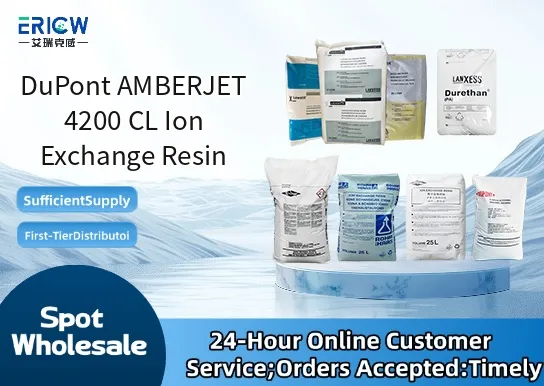
High-capacity, gel-type strong base anion exchange resin with Type I functionalization.
Optimized for low-silica removal and high chloride selectivity in mixed-bed and polishing applications.
Excellent physical and chemical stability across a wide pH range (0–14) and temperature up to 60 °C.
Low total organic carbon (TOC) extractables, minimizing post-treatment contamination in ultrapure water systems.
Consistent bead quality and narrow particle size distribution for uniform hydraulic performance and reduced pressure drop.
Final polishing stage in semiconductor-grade ultrapure water (UPW) production systems.
Power plant condensate polishing for steam cycle purity and corrosion control.
Pharmaceutical water purification meeting USP <701>, EP, and JP pharmacopeial requirements.
Electronics manufacturing process water where low sodium, silica, and TOC are critical.
Mixed-bed configurations with cation resins for high-resistivity water generation (>18.0 MΩ·cm).
| Chemical Type | Strong base anion exchange resin, Type I quaternary ammonium |
| Product Form | Moist, spherical beads |
| Appearance | Off-white to light yellow, translucent beads |
| Functional Group | –N(CH₃)₃Cl |
| Ion Form | Chloride (Cl⁻) |
| Total Exchange Capacity (min.) | 1.2 eq/L (dry) |
| Moisture Content | 45–50% (as shipped) |
| Uniformity Coefficient (max.) | 1.6 |
Q1: What is the primary application of AMBERJET 4200 CL in water treatment systems?
A: AMBERJET 4200 CL is a strongly basic, gel-type Type I anion exchange resin designed primarily for demineralization in mixed-bed and separate-bed deionization systems, especially where high-purity water is required—such as in power generation, microelectronics, and pharmaceutical water production.
Q2: How does AMBERJET 4200 CL differ from other Type I anion resins in terms of physical structure and performance?
A: AMBERJET 4200 CL features uniform spherical beads with high chemical stability and low fines generation. Its optimized crosslinking and particle size distribution support rapid kinetics, low pressure drop in service, and efficient regeneration—making it particularly suitable for high-flow, continuous-operation applications.
Q3: Can AMBERJET 4200 CL be used in mixed-bed configurations with cation resins, and what compatibility considerations apply?
A: Yes, AMBERJET 4200 CL is commonly paired with strong acid cation resins (e.g., AMBERJET 1500 Na or H) in mixed-bed polishing units. It exhibits excellent hydraulic compatibility and minimal resin intermingling due to closely matched density and bead integrity—critical for stable long-term mixed-bed performance and reduced leakage.
Q4: What are the recommended regeneration conditions for AMBERJET 4200 CL?
A: Regeneration is typically performed using sodium hydroxide (NaOH) at concentrations between 2% and 4%, with flow rates and contact times adjusted based on system design and feedwater quality. Optimal regeneration efficiency is achieved when operating within standard temperature limits (5–40°C) and avoiding excessive oxidant exposure.
Contact With Us:
E-mail: wangxingqiang@ericwchem.com
Have a Questions? Call Us:
Add:
Building A1, Jiete Industrial Park, Huangpu District, Guangzhou City, Guangdong Province, China