English
 Español
 tiếng việt
 русский
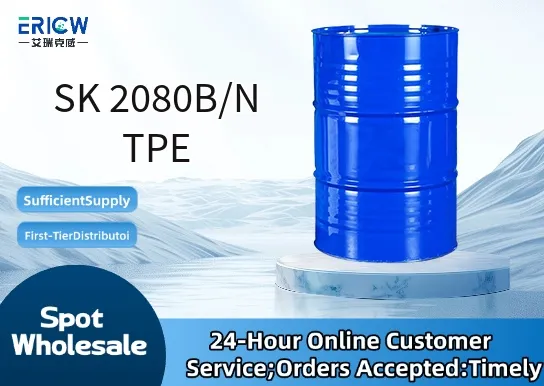
Excellent melt processability for high-speed injection molding and extrusion.
Outstanding soft-touch feel with balanced elasticity and surface tack resistance.
Good compatibility with polypropylene (PP) and ABS substrates for overmolding.
Low compression set for durable sealing and gasketing performance.
RoHS-compliant formulation with no added phthalates or heavy metals.
Soft-grip overmolded handles for power tools and garden equipment.
Ergonomic consumer electronics casings and button overlays.
Seals, gaskets, and flexible caps for automotive interior components.
Medical device grips and non-slip surfaces for handheld diagnostic tools.
Consumer appliance control knobs and tactile interface elements.
| Chemical Type | Thermoplastic Elastomer (TPE) – Styrenic Block Copolymer (SBC) based |
| Product Form | Natural-colored pellets |
| Appearance | Opaque, uniform granules with smooth surface |
| Hardness (Shore A) | 80 ± 3 |
| Melt Flow Rate (230°C/2.16 kg) | 18–22 g/10 min |
| Density (23°C) | 0.92–0.94 g/cm³ |
| Primary Applications | Overmolding, soft-touch components, seals & gaskets |
| Key Features | Easy processing, PP/ABS adhesion, low compression set, RoHS compliant |
Q1: What is the primary function of SK 2080B/N TPE in polymer formulations?
A: SK 2080B/N TPE is a thermoplastic elastomer modifier designed to enhance flexibility, impact resistance, and melt processability—particularly in rigid polypropylene (PP) and polyethylene (PE) systems. It functions as a compatibilized soft-phase component that improves toughness without significantly compromising stiffness or thermal stability.
Q2: Is SK 2080B/N TPE suitable for injection molding applications?
A: Yes—SK 2080B/N TPE is specifically engineered for conventional thermoplastic processing methods, including injection molding, extrusion, and blow molding. Its balanced melt viscosity and thermal stability support consistent flow and good demolding behavior across standard processing windows.
Q3: How does SK 2080B/N TPE differ from conventional SEBS-based TPEs?
A: Unlike generic SEBS grades, SK 2080B/N TPE features a tailored styrenic block architecture with optimized ethylene–butylene mid-block crystallinity and controlled hydrogenation. This delivers improved thermal resilience, reduced compression set, and better compatibility with semi-crystalline polyolefins—making it especially effective in PP/EPDM-like blends.
Q4: Can SK 2080B/N TPE be used in food-contact applications?
A: SK 2080B/N TPE is formulated without intentionally added heavy metals, phthalates, or primary aromatic amines. While it is not pre-certified for food contact, its composition aligns with common regulatory expectations for indirect food-contact polymers—final compliance depends on full formulation review and end-use validation by the processor.
Contact With Us:
E-mail: wangxingqiang@ericwchem.com
Have a Questions? Call Us:
Add:
Building A1, Jiete Industrial Park, Huangpu District, Guangzhou City, Guangdong Province, China