English
 Español
 tiếng việt
 русский
Excellent processability via injection molding and extrusion with low energy consumption.
Superior soft-touch feel and high elasticity retention across wide temperature ranges.
Good resistance to UV exposure and long-term thermal aging (up to 70 °C continuous service).
Compatible with polypropylene (PP) and polyethylene (PE) substrates for overmolding applications.
Halogen-free formulation meeting RoHS and REACH compliance requirements.
Automotive interior trim components including door panels, armrests, and console covers.
Consumer electronics casings and protective grips for power tools and handheld devices.
Household appliance seals, gaskets, and soft-touch control buttons.
Medical device housings requiring skin-safe, non-phthalate elastomeric properties.
Industrial grips and ergonomic handles for hand tools and equipment.
| Chemical Type | Thermoplastic Elastomer (TPE), SEBS-based |
| Product Form | Pellets |
| Appearance | Translucent, natural color granules |
| Hardness (Shore A) | 75 ± 3 |
| Melt Flow Rate (190 °C/5 kg) | 18–22 g/10 min |
| Density | 0.92–0.94 g/cm³ |
| Key Features | Soft-touch, PP/PE adhesion, recyclable, low extractables |
| Compliance | RoHS 2015/863/EU, REACH SVHC-free, FDA indirect food contact compliant (21 CFR 177.2600) |
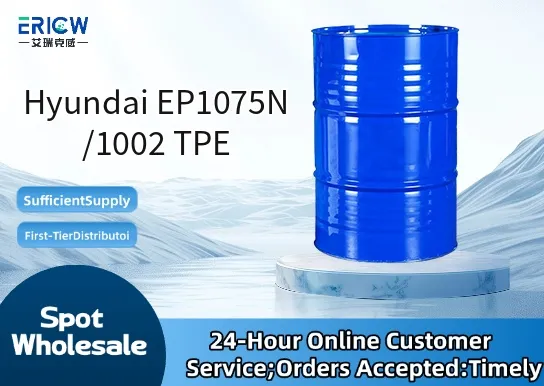
Q1: What is the primary function of Hyundai EP1075N/1002 TPE in polymer formulations?
A: Hyundai EP1075N/1002 TPE is a thermoplastic elastomer designed primarily as a compatibilizer and impact modifier for polyolefin-based systems, especially in PP/EPDM blends. It enhances melt flow, improves interfacial adhesion between immiscible phases, and contributes to balanced stiffness-toughness performance.
Q2: Is EP1075N/1002 suitable for applications requiring flexibility and soft-touch feel?
A: Yes — its elastomeric nature and low Shore A hardness enable effective use in soft-touch overmolding, grip components, and flexible automotive interior parts. Performance in such applications depends on base resin selection and processing conditions, but it consistently supports improved elasticity and surface comfort without compromising processability.
Q3: How is EP1075N/1002 typically incorporated into compound formulations?
A: It is commonly added during twin-screw extrusion compounding, either directly with base resins or as a pre-blend. Dosage generally ranges from 0.1% to 2% by weight depending on the desired balance of toughness, flow, and phase morphology — with higher loadings used where enhanced impact resistance or finer dispersion is targeted.
Q4: Does EP1075N/1002 require special drying before processing?
A: While not highly hygroscopic, it is recommended to dry EP1075N/1002 at 60–70 °C for 2–4 hours prior to high-precision or high-temperature processing (e.g., thin-wall injection molding) to minimize potential surface defects and ensure optimal melt consistency.
Q5: Can EP1075N/1002 be used in food-contact or medical-grade compounds?
A: EP1075N/1002 is not pre-certified for food-contact or medical applications. Its suitability for such uses depends entirely on full formulation validation, including regulatory review of all components, processing history, and end-use conditions. Customers must conduct their own compliance assessment per applicable regional requirements.
Contact With Us:
E-mail: wangxingqiang@ericwchem.com
Have a Questions? Call Us:
Add:
Building A1, Jiete Industrial Park, Huangpu District, Guangzhou City, Guangdong Province, China