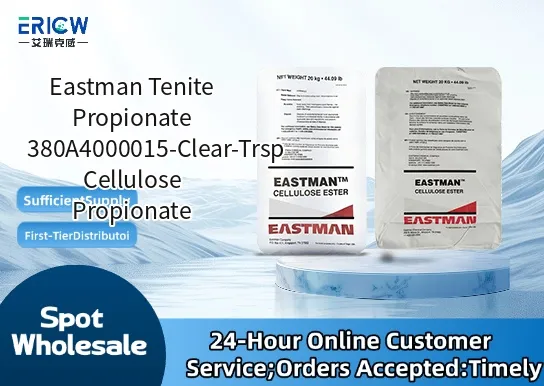
Features Of Eastman Tenite Propionate 380A4000015-Clear-Trsp Cellulose Propionate
Exceptional optical clarity and high-gloss surface finish for premium aesthetic applications.
Good dimensional stability with low moisture absorption compared to other cellulose esters.
Excellent thermoformability and ease of processing via injection molding, extrusion, and vacuum forming.
Outstanding resistance to oils, greases, and many common solvents.
USP Class VI and FDA-compliant for indirect food contact and medical device components (subject to validation).
Typical Applications Of Eastman Tenite Propionate 380A4000015-Clear-Trsp Cellulose Propionate
Transparent lenses and optical components for consumer electronics and instrumentation.
Medical device housings, diagnostic instrument windows, and sterilizable equipment parts.
High-clarity packaging for cosmetics, pharmaceuticals, and premium consumer goods.
Automotive interior trim, gauge covers, and decorative overlays requiring scratch resistance and gloss retention.
Specifications Of Eastman Tenite Propionate 380A4000015-Clear-Trsp Cellulose Propionate
| Chemical Type | Cellulose propionate |
| Product Form | Pellets |
| Appearance | Clear, transparent, colorless |
| Primary Applications | Optical components, medical devices, premium packaging, automotive trim |
| Key Features | Clarity, thermoformability, solvent resistance, low moisture uptake |
| Benefits | Reduced need for secondary polishing, excellent surface aesthetics, regulatory compliance readiness |
| Processing Methods | Injection molding, extrusion, thermoforming, vacuum forming |
Eastman Tenite Propionate 380A4000015-Clear-Trsp Cellulose Propionate – Frequently Asked Questions (FAQ)
Q1: What are the key processing advantages of Eastman Tenite Propionate 380A4000015 compared to other cellulose esters?
A: This grade offers excellent melt stability and low-temperature processability, enabling efficient extrusion and injection molding without excessive thermal degradation. Its balanced molecular weight distribution supports good flow characteristics while maintaining mechanical integrity in thin-walled or optically demanding parts.
Q2: Is this material suitable for applications requiring optical clarity and UV stability?
A: Yes — Eastman Tenite Propionate 380A4000015 is formulated to deliver high transparency and consistent color stability. It exhibits inherently good resistance to yellowing under ambient and moderate UV exposure, making it appropriate for transparent lenses, display components, and premium consumer product housings where long-term visual performance matters.
Q3: How does this grade perform in terms of chemical resistance and compatibility with common plasticizers or additives?
A: It demonstrates good resistance to aliphatic hydrocarbons, oils, and weak acids, though it is less resistant to strong solvents like ketones or esters. The polymer is compatible with a range of standard plasticizers (e.g., triethyl citrate, acetyl tributyl citrate) and stabilizers commonly used in cellulose ester formulations, supporting tailored flexibility and processing behavior.
Q4: Can this material be used in applications involving repeated sterilization or high-humidity environments?
A: While not intended for repeated autoclaving, Eastman Tenite Propionate 380A4000015 maintains dimensional stability and clarity under intermittent steam exposure and elevated humidity conditions typical of medical device packaging or humidified consumer electronics enclosures. Long-term immersion or continuous high-temperature sterilization is not recommended.
 English
 Español
 tiếng việt
 русский